
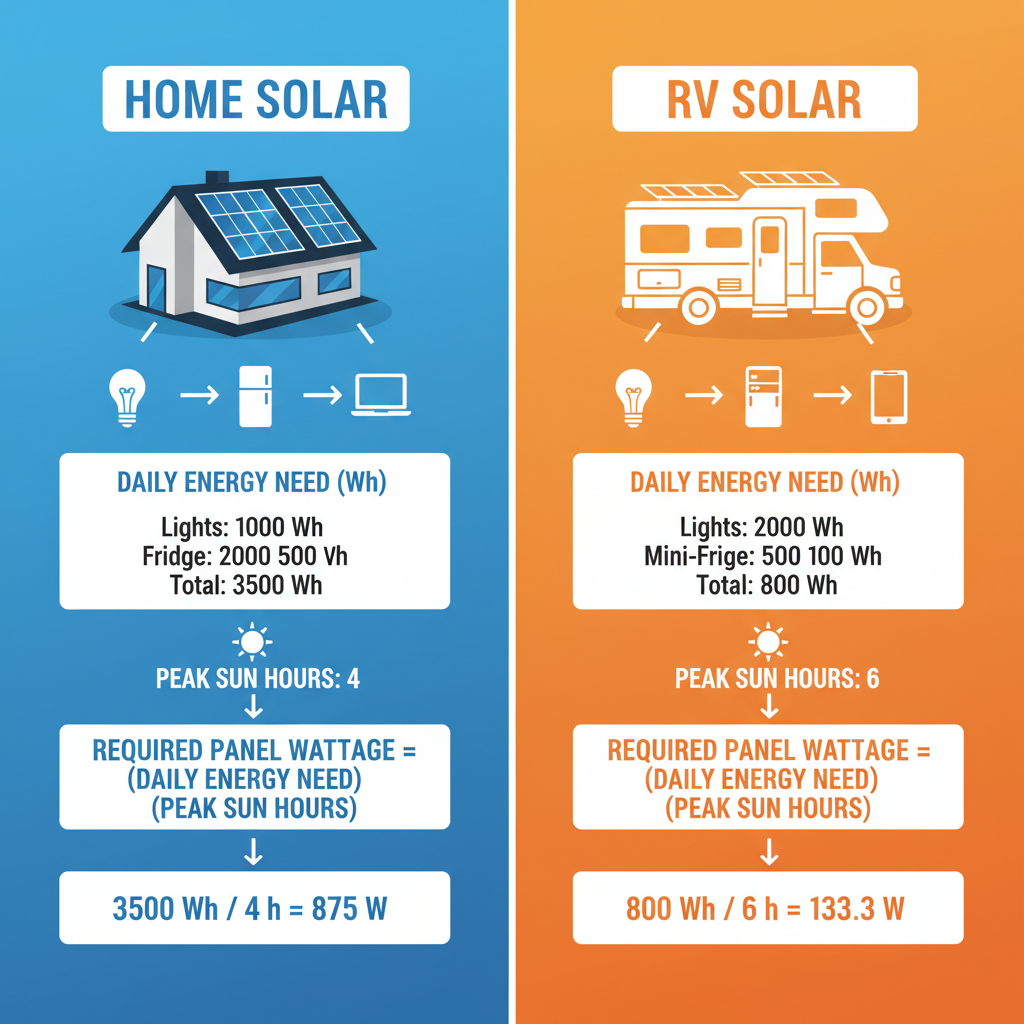
Getting your solar panel sizing right is the foundation of any successful solar power system. Whether you’re planning a home installation or setting up your RV for off-grid adventures, understanding how much power you actually need can save you thousands of dollars and countless headaches down the road.
Too many DIY solar enthusiasts make the mistake of either over-buying expensive panels they don’t need or under-sizing their system and dealing with power shortages. Let’s walk through the simple math together so you can confidently size your solar array for your specific needs.
Why Proper Solar Panel Sizing Matters
Before we dive into calculations, let’s understand why getting this right is so important. An oversized system means you’re paying for panels that aren’t earning their keep. An undersized system leaves you scrambling for power when you need it most.
Moreover, your solar panel size directly affects every other component in your system. Battery bank capacity, inverter size, and charge controller specifications all depend on how much solar power you’re generating.
The good news? With some basic math and honest assessment of your power usage, you can nail the sizing on your first try.
Step 1: Calculate Your Daily Energy Consumption
First things first – you need to know how much electricity you actually use. This is where most people get overwhelmed, but we’ll keep it simple.
Start by making a list of all the devices you plan to run on solar power. For each device, you’ll need to know:
- Watts (power consumption)
- Hours used per day
Here’s a practical example for a typical RV setup:
- LED lights (40W × 5 hours) = 200 watt-hours
- Laptop (65W × 4 hours) = 260 watt-hours
- Phone charger (20W × 2 hours) = 40 watt-hours
- 12V fridge (60W × 8 hours) = 480 watt-hours
- Water pump (120W × 1 hour) = 120 watt-hours
Total daily consumption: 1,100 watt-hours (or 1.1 kWh)
Pro Tips for Accurate Load Calculations
Don’t forget about phantom loads – devices that draw power even when not actively in use. Things like inverters on standby, charge controllers, and monitoring systems can add 50-100 watts of continuous draw.
Additionally, consider seasonal variations. Your power needs might be higher in winter (more indoor time, heating) or summer (fans, air conditioning).
Step 2: Account for System Inefficiencies
Real-world solar systems aren’t 100% efficient. Energy gets lost during battery charging, DC-to-AC conversion, and through wiring resistance.
A good rule of thumb is to multiply your daily energy needs by 1.3 to account for these losses. Using our RV example:
1,100 watt-hours × 1.3 = 1,430 watt-hours needed from your solar panels
This buffer ensures you’ll have enough power even on slightly cloudy days or when your system isn’t performing at peak efficiency.
Step 3: Factor in Available Sunlight Hours
Not all sunlight hours are created equal. Solar panels produce their rated power only under ideal conditions – typically defined as 1,000 watts per square meter of solar irradiance at 25°C.
What you need to know is your location’s “peak sun hours” – the equivalent hours of peak solar irradiance per day. This varies dramatically by location and season.
Peak Sun Hours by Region
Here are some average peak sun hours for different U.S. regions:
- Southwest (Arizona, Nevada): 6-7 hours
- California: 5-6 hours
- Florida: 4.5-5.5 hours
- Northeast: 3-4 hours
- Pacific Northwest: 2.5-3.5 hours
For our RV example, let’s assume we’re traveling through areas with an average of 5 peak sun hours per day.
Step 4: Calculate Required Solar Panel Wattage
Now for the main calculation! Divide your adjusted daily energy needs by your available peak sun hours:
Required Solar Wattage = Daily Energy Needs ÷ Peak Sun Hours
Using our example: 1,430 watt-hours ÷ 5 hours = 286 watts
This means you’d need approximately 300 watts of solar panels to meet your daily energy requirements.
Real-World Solar Panel Sizing Example
Let’s work through a home backup power scenario. Say you want to keep essential circuits running during outages:
- Refrigerator: 150W × 8 hours = 1,200Wh
- Lights: 100W × 6 hours = 600Wh
- Internet/router: 50W × 12 hours = 600Wh
- Phone charging: 30W × 2 hours = 60Wh
Daily total: 2,460 watt-hours × 1.3 efficiency factor = 3,200 watt-hours
With 4 peak sun hours: 3,200 ÷ 4 = 800 watts of solar panels needed
Choosing the Right Panel Configuration
Once you know your total wattage requirement, you’ll need to decide on panel configuration. Solar panels commonly come in 100W, 200W, 300W, and 400W sizes.
For our 300W RV example, you could choose:
- Three 100W panels
- One 300W panel
- Two 150W panels
Each configuration has trade-offs in terms of installation flexibility, shading tolerance, and cost.
Panel Layout Considerations
Multiple smaller panels offer better performance in partial shade conditions. However, larger panels typically offer better value per watt and require less mounting hardware.
Furthermore, consider your available roof space. Sometimes physical constraints dictate panel choice more than electrical requirements.
Common Solar Panel Sizing Mistakes to Avoid
Don’t fall into these common traps that catch many DIY solar installers:
Mistake #1: Forgetting about cloudy days. Build in a 20-30% buffer for less-than-perfect weather conditions.
Mistake #2: Using nameplate ratings. Solar panels rarely produce their full rated power in real-world conditions.
Mistake #3: Ignoring battery capacity. Your battery bank needs to store at least one day’s worth of energy, preferably two or three days.
Mistake #4: Not planning for growth. Consider future power needs when sizing your system. It’s easier to install extra capacity now than to add panels later.
Fine-Tuning Your Solar Panel Sizing
Once you’ve calculated your baseline requirements, consider these refinements:
Seasonal adjustments might require 20-30% more capacity for winter months in northern climates. Battery aging also reduces capacity over time, so factor in 10-15% extra capacity to maintain performance as your batteries age.
Installation angle and orientation affect output too. Non-optimal mounting can reduce production by 10-25%.
Budget-Friendly Sizing Strategies
If your calculated requirements exceed your budget, consider these cost-effective approaches:
Start with a smaller system that covers your most critical loads. You can always expand later. Focus on energy efficiency first – LED bulbs and efficient appliances reduce your solar requirements significantly.
Consider seasonal usage patterns. Maybe you only need full capacity during certain months of the year.
Ready to Size Your Solar System?
Getting your solar panel sizing right doesn’t have to be complicated. By honestly assessing your power needs, accounting for system losses, and understanding your local solar resources, you can design a system that delivers reliable power without breaking the bank.
Remember, it’s better to slightly oversize than to come up short. The peace of mind of having adequate power is worth the small additional investment. Start with these calculations, then refine based on your specific situation and budget.
Have questions about your specific solar panel sizing scenario? The calculations we’ve covered here work for 95% of DIY solar installations, but every situation has unique considerations worth discussing.