
Choosing the right solar battery chemistry for your DIY system feels like picking between pizza and tacos – they’re both good, but in different ways. I’ve made expensive mistakes with both AGM and lithium batteries, so let me save you some headaches (and money).
The truth is, neither battery type is universally “better.” Your budget, use case, and tolerance for maintenance will determine which one makes sense. Let’s dig into the real differences.
Understanding Solar Battery Chemistry Basics
Before we dive into the AGM vs lithium showdown, let’s get the fundamentals straight. Your solar battery stores the energy your panels collect during sunny days for use when the sun isn’t shining.
Think of it like a bank account for electrons. Some batteries are like checking accounts – easy access but lower returns. Others are like investment accounts – higher upfront costs but better long-term value.
The chemistry inside determines everything: how long they last, how much maintenance they need, and how well they handle temperature extremes.
AGM Batteries: The Reliable Workhorse
AGM (Absorbed Glass Mat) batteries are like the Honda Civic of the battery world. Not flashy, but dependable and affordable.
AGM Advantages
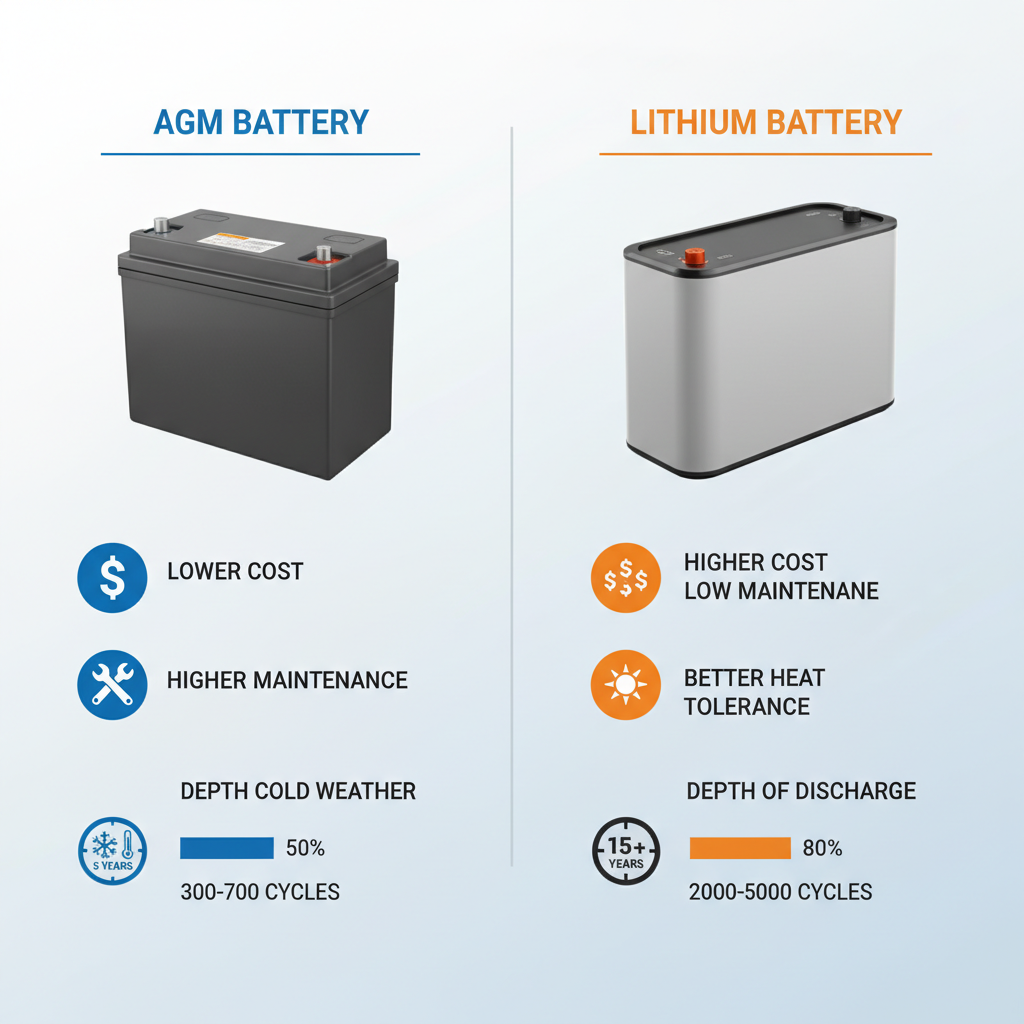
First, the price point won’t make you question your life choices. AGM batteries typically cost 50-70% less than lithium upfront. For a basic home backup system, that’s significant savings.
They’re also bulletproof in terms of charging equipment. Any decent solar charge controller will work fine with AGM. No special programming or expensive Battery Management Systems required.
Temperature tolerance is another win. AGM batteries handle cold better than lithium, making them solid choices for cabins or northern climates.
AGM Disadvantages
However, AGM batteries are heavy. Like, “why did I decide to install this myself” heavy. A typical 100Ah AGM weighs 60-65 pounds versus 25-30 pounds for equivalent lithium.
They also have limited depth of discharge. You can only use about 50% of their rated capacity without damaging them. That 100Ah battery? Really only gives you 50Ah of usable power.
Lifespan is shorter too. Expect 3-5 years with proper care, maybe 7-8 if you baby them.
Lithium Batteries: The High-Performance Option
Lithium batteries are like Tesla – expensive upfront but impressive performance. Specifically, we’re talking LiFePO4 (Lithium Iron Phosphate), not the lithium-ion in your phone.
Lithium Advantages
The depth of discharge is game-changing. You can safely use 80-90% of a lithium battery’s capacity. That same 100Ah battery gives you 80-90Ah of actual power.
Lifespan blows AGM out of the water. Quality lithium batteries last 10-15 years, some even longer. They’re rated for 3,000-5,000 cycles versus 500-800 for AGM.
Weight savings matter too, especially for RV installations. Half the weight means easier mounting and less stress on your roof.
Lithium Disadvantages
The sticker shock is real. Lithium batteries cost 2-3 times more than AGM upfront. A decent 100Ah lithium runs $800-1,200 versus $200-300 for AGM.
Cold weather performance suffers. Most lithium batteries shut down charging below 32°F and have reduced capacity in cold temps.
You also need compatible charging equipment. Some older charge controllers don’t have lithium profiles, requiring upgrades.
Real-World Performance Comparison
Let’s talk numbers that actually matter in your daily life.
For energy storage, that 100Ah AGM gives you about 600Wh of usable power (50% depth of discharge at 12V). The lithium gives you 960Wh (80% depth of discharge). That’s 60% more actual energy storage.
Charging speed differs dramatically too. AGM batteries charge slowly and need a multi-stage process. Lithium batteries can accept charge much faster, reaching full capacity in 2-3 hours versus 6-8 hours for AGM.
This matters when you’re trying to capture every bit of sunlight. After you’ve properly sized your solar panels using our solar panel sizing guide, lithium batteries let you store that power more efficiently.
Temperature Performance Deep Dive
Temperature affects both battery types, but differently.
AGM batteries lose about 50% of their capacity at 0°F but keep working. They’ll charge slowly in cold weather but won’t shut down completely.
Lithium batteries maintain better capacity in moderate cold but have hard cutoff points. Most stop charging below 32°F and may shut down completely below 0°F.
For hot climates, lithium wins. They handle heat better and don’t suffer the thermal runaway issues of some other lithium chemistries.
Maintenance Requirements
Here’s where your personality matters as much as your budget.
AGM batteries are “maintenance-free” in that you can’t add water, but they still need attention. You should equalize them monthly, check voltage regularly, and keep terminals clean.
Lithium batteries are truly set-and-forget. No equalization, no specific gravity checks, minimal voltage monitoring. The built-in Battery Management System handles most of the work.
If you’re the type who forgets to change your car’s oil until the light comes on, lithium might be worth the extra cost just for peace of mind.
Budget Analysis: Total Cost of Ownership
The upfront cost difference is obvious, but let’s look at the real numbers over time.
AGM battery bank: $1,200 initial cost, replaced every 5 years = $2,400 over 10 years.
Lithium battery bank: $3,000 initial cost, lasts 10+ years = $3,000 over 10 years.
When you factor in the extra usable capacity and lower maintenance, lithium often breaks even around year 6-8.
However, this assumes you have the upfront capital and plan to keep the system long-term. If you’re testing the waters or need to spread costs over time, AGM makes more sense.
Which Chemistry for Your Use Case?
Choose AGM if you:
- Have a tight budget upfront
- Live in very cold climates
- Need a temporary or starter system
- Have existing equipment that works better with AGM
- Don’t mind regular maintenance
Choose lithium if you:
- Want maximum performance and efficiency
- Plan to keep the system 10+ years
- Need lightweight batteries (RV applications)
- Prefer minimal maintenance
- Live in moderate to hot climates
For RV applications especially, lithium makes sense if you can afford it. The weight savings and maintenance reduction are worth the premium when you’re boondocking. Our RV solar mounting guide covers the structural considerations.
Hybrid Approaches and Future Planning
You don’t have to choose just one chemistry forever. Many DIYers start with AGM to learn the system, then upgrade to lithium later.
This approach lets you spread costs and gain experience before making the bigger investment. Just make sure your charge controller and inverter setup can handle both battery types.
Some systems even run mixed banks, though this requires careful planning and separate charging circuits. Generally not recommended for beginners.
Making Your Decision
The best solar battery chemistry is the one that fits your actual needs, not the one that looks best on paper.
If you’re building your first system and want to minimize risk, AGM is perfectly fine. You’ll learn the basics without breaking the bank. If you’re serious about long-term solar power and can handle the upfront cost, lithium delivers better value over time.
Either way, you’re making a smart move toward energy independence. The “perfect” battery is the one that gets you started, not the one you read about in forums.
Remember, your battery bank is just one part of the system. Make sure you’ve properly sized everything else first – batteries won’t fix an undersized solar array or wrong inverter choice.