
When I started building my first solar setup, every forum warrior was arguing about micro-inverters vs string like they were designing a 50kW solar farm. Meanwhile, I’m sitting here with 400 watts wondering if I need to take out a second mortgage just to get some power flowing.
Here’s the thing nobody tells you: the micro-inverters vs string debate looks completely different when you’re building a small DIY system where every dollar actually matters. Let me save you the headache I went through trying to figure this out.
What Are Micro-Inverters and String Inverters Actually?
Before we dive into the money talk, let’s get our terms straight. I learned this the hard way after buying the wrong equipment twice.
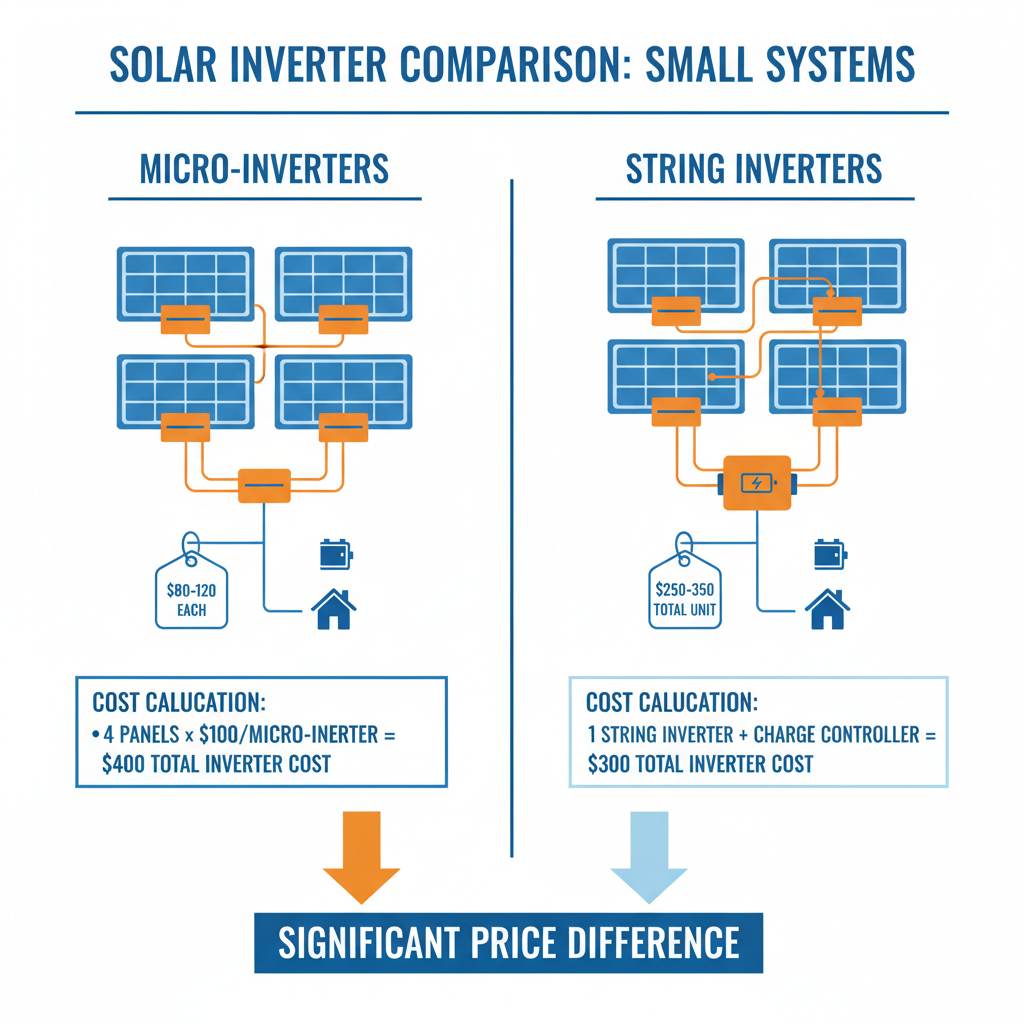
String inverters are the old-school approach. One central unit converts DC from all your panels to AC. Think of it like having one big power adapter for your entire system.
Micro-inverters are tiny inverters that attach to each individual panel. Each panel gets its own personal DC-to-AC converter. It’s like giving every panel its own dedicated power adapter.
Both do the same basic job. The question is which makes sense for your wallet and your actual power needs.
The Real Micro-Inverters vs String Cost Breakdown
Let me hit you with some actual numbers from my 400W setup research. These prices will make you understand why I spent three weeks agonizing over this decision.
String Inverter Costs (400W System)
A decent 400W MPPT charge controller runs about $80-120. Add basic monitoring for another $50. You’re looking at $130-170 total for the power conversion side of things.
That’s it. One purchase, done.
Micro-Inverter Costs (400W System)
Quality micro-inverters cost $80-120 each. For a 400W system using 100W panels, you need four of them. That’s $320-480 just for the inverters.
Plus you still need monitoring equipment if you want to see what’s happening. Add another $100-200 for a decent monitoring system.
Total: $420-680. Ouch.
When Micro-Inverters Actually Make Sense
Now I’m not saying micro-inverters are bad. They solve real problems. Just not necessarily your problems if you’re starting small.
Micro-inverters shine when you have shading issues. If one panel gets shaded with string setup, it drags down the whole string’s performance. With micros, only that one panel suffers.
But here’s the reality check: if you did your solar shade analysis properly, you already picked a location without significant shading problems.
They also help when panels face different directions. But again, if you’re building a small rooftop or RV system, you’re probably putting all panels in the same orientation anyway.
The String Inverter Reality for Small Systems
For most beginner setups, string inverters (or MPPT charge controllers in off-grid systems) just make more financial sense. The math is brutal but simple.
That $250-500 you save on micro-inverters? That’s another 100W panel. Or better yet, it’s most of your battery storage costs.
Plus, troubleshooting is way simpler. One inverter fails, you know where to look. Four micro-inverters fail, and you’re playing electrical hide-and-seek on your roof.
The Performance Difference Reality
In perfect conditions with no shading, micro-inverters might give you 2-5% better performance. On a 400W system, that’s 8-20 watts.
To put that in perspective, 20 watts runs… one LED light bulb. Maybe. If you’re lucky.
That extra performance would take about 15-20 years to pay for the additional cost. By then, you’ll probably want to upgrade your entire system anyway.
What I’d Do Differently (And What You Should Consider)
If I were building my 400W system again, I’d go string every time. Take that money saved and put it toward:
Better monitoring. A good monitoring system tells you exactly what’s happening with your power production. Way more useful than marginally better performance.
More capacity. Another panel or better battery storage gives you actual usable power increases, not theoretical ones.
Quality components. Better wiring, fusing, and mounting hardware that won’t fail in five years.
The Exception: Future Expansion Plans
Here’s one scenario where micro-inverters might make sense for small systems: if you’re absolutely certain you’ll be expanding significantly within a few years.
Adding panels to a micro-inverter system is dead simple. Just add another panel with its micro-inverter. Done.
With string systems, you need to make sure your charge controller can handle the additional capacity. Sometimes you need to upgrade the entire controller.
But honestly? Most people say they’ll expand and never do. Start with what you need now, not what you think you might need later.
Installation Complexity: Another Hidden Cost
Micro-inverters mean more connections, more potential failure points, and more things to troubleshoot when something goes wrong.
Each micro-inverter needs proper grounding and secure mounting. Multiply that by four for a basic system, and you’re spending a lot more time on your roof.
String systems have fewer connection points. Less complexity usually means fewer problems down the road.
And when something does go wrong, troubleshooting a single charge controller is much easier than diagnosing which of four micro-inverters decided to take a vacation.
The Bottom Line: Math Doesn’t Lie
Look, I get the appeal of micro-inverters. They sound more advanced, more sophisticated. Everyone in the solar forums talks about them like they’re the obvious choice.
But for small DIY systems where every dollar counts, the numbers just don’t add up. You’re paying 2-3x more for maybe 2-5% better performance in ideal conditions.
That money is better spent on system capacity, quality components, or just keeping it in your pocket for the next project.
My Recommendation for Beginners
Start with a string setup for your first system. Learn how solar actually works without blowing your budget on marginal improvements.
Once you understand your real power needs and usage patterns, then consider if micro-inverters make sense for your specific situation.
Remember, the best solar system is the one you can actually afford to build and that meets your actual power needs.
Don’t let forum warriors convince you that you need enterprise-grade solutions for a basic DIY setup. Save your money, build something that works, and upgrade later when you know what you’re actually doing.
Trust me on this one. Your wallet will thank you.