
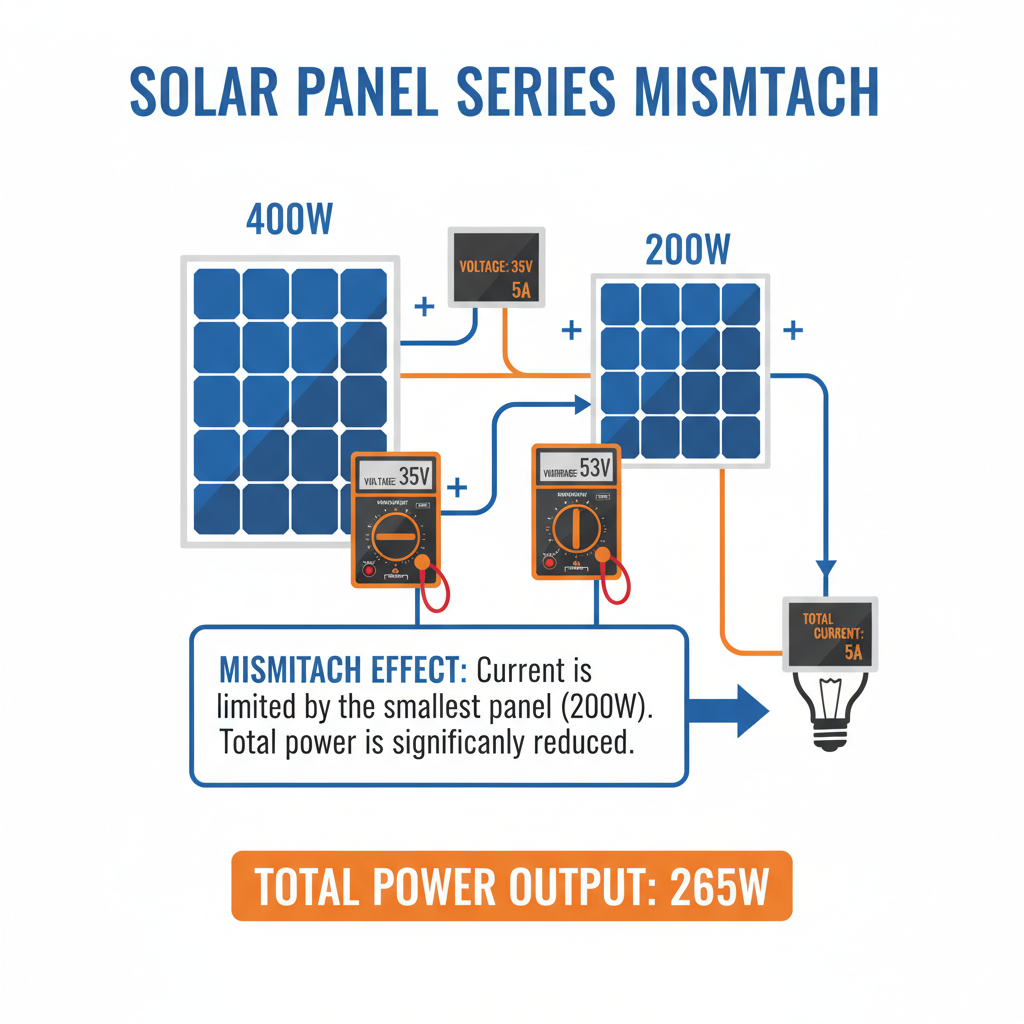
Found some used panels on Facebook Marketplace and thought you’d be clever mixing them with your existing setup? I tried the same thing with my RV system. Watched my power output drop by 40% overnight. Turns out panel mismatch is like putting a garden hose connector on a fire hose – everything slows down to match the weakest link.
Don’t feel bad. We’ve all been there. You see those shiny new 400W panels next to your trusty old 200W workhorses and think “more panels equals more power.” Physics has other plans.
Why Panel Mismatch Murders Your Power Output
Here’s the brutal truth about mixing different solar panels: they don’t play nice together. At all.
When you wire panels in series (which you probably are), the current gets limited by the weakest panel in the string. Think of it like a chain – doesn’t matter how strong most links are if one’s made of tissue paper.
Your new 400W panel might be capable of pumping out 10 amps. But if it’s wired with an old 200W panel that maxes out at 6 amps, guess what your whole string produces? Six amps. The 400W panel just became an expensive 240W panel.
I learned this the expensive way. Added two mismatched panels to my existing setup and spent three days troubleshooting why my solar load testing showed terrible numbers. Spoiler alert: it wasn’t the wiring.
The Real Culprits Behind Panel Mismatch Problems
Not all mismatches are created equal. Some kill your system. Others just make it less efficient.
Voltage differences are usually manageable. Mix a 12V and 18V panel? Your charge controller will sort it out. Modern MPPT controllers are pretty forgiving about voltage variations.
Current mismatches are the real killers. This is where everything goes sideways. Your 10-amp panel gets dragged down to match your 6-amp panel. Every. Single. Time.
Age differences matter more than you’d think. That five-year-old panel isn’t producing what the specs say anymore. Solar panels degrade about 0.5% per year. Your “300W” panel might actually be a 285W panel now.
Temperature coefficients also vary between manufacturers. One panel loves hot weather, another hates it. Wire them together and they’ll fight each other all day long.
How to Actually Mix Different Panels (The Safe Way)
Before you toss those mismatched panels on Craigslist, there are ways to make this work. You just need to be smarter about it.
Separate strings are your friend. Run each panel type on its own string to your charge controller. Most controllers can handle multiple inputs. Problem solved.
This is where micro-inverters vs string inverters becomes relevant. Micro-inverters let each panel work independently. No more weakest-link problems.
Match current ratings as closely as possible. If you must wire different panels in series, keep the current ratings within 10% of each other. Your 9-amp and 10-amp panels will play together reasonably well.
Group by age. Put all your old panels on one string, new ones on another. They’ll have similar degradation patterns and won’t drag each other down.
I retrofitted my system this way after the mismatch disaster. Separated my old 200W panels from the new 300W ones. Power output jumped back up to where it should be.
Real-World Panel Mismatch Solutions
Let’s get practical. You’ve got panels that don’t match, and you need them to work together. Here’s what actually works in the field.
The multiple string approach works best for most DIY systems. Wire similar panels together, run separate DC lines to your charge controller. Yeah, it means more wire and potentially more combiner boxes, but your power output will thank you.
Power optimizers are another option if you’re feeling fancy. They’re like mini MPPT controllers for each panel. Let every panel work at its own maximum power point. More expensive than doing it the simple way, but sometimes necessary.
Accept the compromise might be your most realistic option. If you’re already wired up and just adding one mismatched panel, sometimes you live with the efficiency hit. Run the numbers first though. Make sure you’re not losing more power than you’re gaining.
Whatever you do, don’t ignore wire gauge calculations when adding panels. More current means bigger wires, especially over long runs.
When Panel Mismatch Actually Makes Sense
Sometimes mixing panels is the right move. Weird, I know.
Different orientations can work great with mismatched panels. East-facing panels peak in the morning, west-facing ones peak in the afternoon. Mix different wattages and you might get more consistent power throughout the day.
This ties into solar panel orientation strategy. Maybe your roof forces you to put some panels in less-than-ideal spots. Use smaller panels there, bigger ones in the prime real estate.
Budget constraints are real. If buying all matching panels means waiting six months, and you need power now, strategic mismatching might make sense. Just do it smartly.
Expansion phases almost always involve some mismatch. You start with what you can afford, add more later. Plan for this from the beginning and it’s not a problem.
Testing Your Mixed Panel Setup
Don’t trust the math. Test your actual setup.
Get yourself a decent multimeter and measure actual current and voltage from each string. Compare to what you calculated. If the numbers are way off, you’ve got a mismatch problem.
Load testing your whole system will tell you if your panel mixing worked or not. No guessing, just real numbers.
Check power output at different times of day. Mismatched panels often show weird performance curves. Morning might look great, afternoon terrible, or vice versa.
Monitor for hot spots on panels too. Mismatched current can cause some panels to run hotter than they should. That’s your signal to separate the strings.
The Bottom Line on Panel Mismatch
Panel mismatch isn’t the end of the world, but it’s not something to ignore either. Done wrong, it kills your power output. Done right, it can actually improve your system flexibility.
The key is understanding what you’re dealing with. Match current ratings when you must wire in series. Use separate strings whenever possible. Don’t mix panels with big age differences unless you have to.
Most importantly, test everything. Your multimeter doesn’t lie, even when your calculations look perfect on paper. I learned that lesson the hard way so you don’t have to.
Remember, the goal isn’t perfect matching – it’s maximum power production for your specific situation. Sometimes that means embracing the mismatch and working with it instead of against it.