
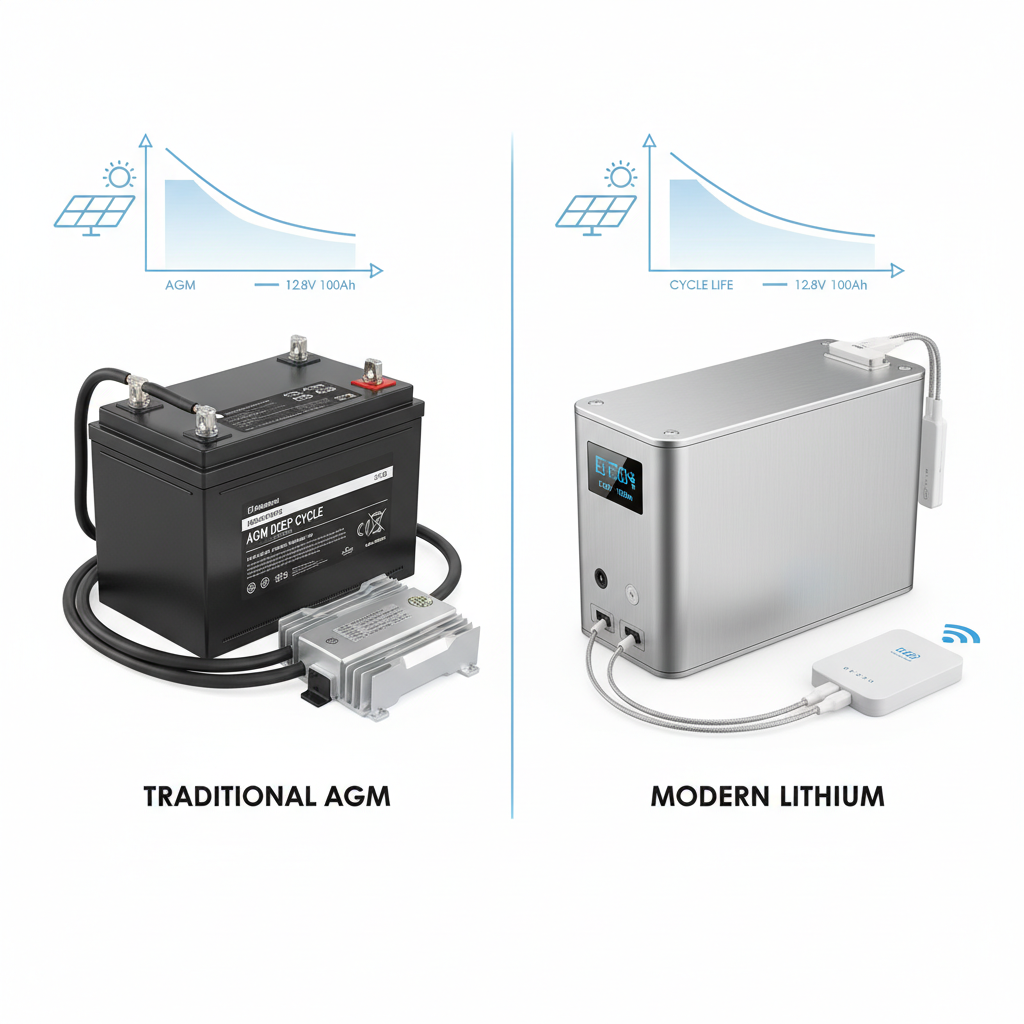
When I first started building solar battery chemistry systems, I made every mistake you’re probably worried about. Bought the wrong batteries twice. Learned the hard way that “deep cycle” doesn’t mean what I thought it meant. And yes, I once killed a perfectly good AGM battery in three months because nobody told me about sulfation.
Here’s what I wish someone had explained to me upfront: choosing between AGM and lithium isn’t just about price. It’s about matching the chemistry to your actual use case. Get it wrong, and you’ll be replacing batteries way sooner than you planned.
Why Battery Chemistry Matters More Than You Think
Most DIY guides skip the fundamentals and jump straight to “buy this battery.” That’s backwards. Understanding how different chemistries actually work will save you hundreds of dollars and years of frustration.
Battery chemistry determines everything. How deep you can discharge without damage. How many cycles you’ll get. Whether they’ll work in your RV during a Montana winter. Even how you need to wire your charge controller.
I learned this the expensive way. You don’t have to.
AGM Batteries: The Reliable Workhorse
AGM stands for Absorbed Glass Mat. Think of it as lead-acid batteries that don’t spill and hate being completely drained.
AGM Strengths
AGM batteries are forgiving. Overcharge them a bit? They’ll grumble but survive. Wire them wrong? Usually not catastrophic. They’re the Honda Civic of solar batteries.
They handle temperature swings better than most people realize. I’ve run AGM batteries in 110°F Arizona summers and 20°F Colorado winters. Not optimal, but they keep working.
Cost is their biggest advantage. You can build a decent AGM battery bank for half the price of lithium. For weekend warriors or backup power systems, that matters.
AGM Limitations
Here’s where AGM batteries will break your heart: they hate being discharged below 50%. Do it regularly, and you’ll kill them fast.
This means you need twice the battery capacity you actually plan to use. Want 200Ah of usable power? Buy 400Ah of AGM batteries. The math gets expensive quick.
They’re also heavy. Really heavy. My first RV battery bank weighed 240 pounds. Moving it was like wrestling an angry refrigerator.
Lithium Batteries: The High-Performance Option
LiFePO4 (Lithium Iron Phosphate) is the chemistry most DIYers choose. It’s stable, safe, and doesn’t catch fire like other lithium types.
Lithium Advantages
You can discharge lithium batteries to 20% or even 10% without damage. That means a 200Ah lithium battery gives you 160-180Ah of usable power. Try that with AGM and you’re buying new batteries.
Weight difference is dramatic. My 200Ah lithium bank weighs 60 pounds. The equivalent AGM setup? Over 200 pounds. Your RV’s suspension will thank you.
Charging is faster too. Lithium can accept high charge rates right up to 100% capacity. AGM batteries slow down significantly after 80%, extending charge times by hours.
Lithium Drawbacks
Cold weather kills lithium performance. Below freezing, they can’t charge safely. Some have built-in heating, but that adds cost and complexity.
The upfront cost hurts. Quality lithium batteries cost 2-3x more than AGM initially. Though the longer lifespan often balances this out over time.
They’re also less forgiving of electrical mistakes. Wire them wrong or overcharge them, and the consequences can be expensive.
Real-World Performance Comparison
Let me give you numbers that matter. I’ve run both chemistries in identical conditions.
Cycle Life Reality Check
Quality AGM batteries give you 500-800 cycles to 50% depth of discharge. That’s 1-2 years of daily use, depending on your habits.
LiFePO4 batteries deliver 3,000-5,000 cycles to 80% depth of discharge. Same usage pattern? You’re looking at 8-12 years of service life.
Do the math on replacement costs, and lithium often wins despite the higher initial price.
Temperature Performance
I tested both chemistries in Phoenix during July. Ambient temperature hit 115°F, battery compartment reached 135°F.
The AGM batteries lost about 15% capacity but kept working. The lithium batteries hit their thermal protection limit and shut down completely for four hours each afternoon.
Lesson learned: extreme heat affects both, but differently. Plan accordingly.
Maintenance: What They Don’t Tell You
AGM batteries are “maintenance-free” until they’re not. You can’t add water like flooded batteries, but you still need to monitor them.
Check voltage regularly. AGM batteries can sulfate if left discharged, and once that starts, they’re done. I lost two batteries this way before I learned to use a battery monitor.
Lithium batteries need less attention but more sophisticated monitoring. Most quality units have built-in battery management systems (BMS), but you should still track cell voltages if you’re running them hard.
Which Chemistry for Your System?
Choose AGM if you’re building a weekend cabin system, occasional RV use, or emergency backup power. The lower upfront cost makes sense when you’re not cycling daily.
Go lithium for full-time RV living, daily-use off-grid systems, or anywhere weight matters. The extra cost pays back through longer life and deeper discharge capability.
For hybrid approaches, consider starting with AGM and upgrading to lithium later. Just make sure your solar panel sizing can handle the different charging requirements.
Installation Differences That Matter
AGM batteries are plug-and-play with most charge controllers. Set the battery type to AGM, and you’re done.
Lithium needs more attention to charging profiles. Many charge controllers have LiFePO4 settings, but verify the voltage parameters match your specific battery specs.
Wiring is critical for lithium. Poor connections create resistance, resistance creates heat, and heat kills lithium batteries fast. Don’t skip proper wire gauge calculations.
Budget Reality Check
A 400Ah AGM battery bank costs around $600-800. The equivalent 200Ah lithium setup runs $1,200-2,000.
But factor in replacement cycles. Over 10 years, you might replace AGM batteries 3-4 times. Lithium? Probably once, maybe not at all.
Include the hidden costs too. AGM batteries need larger inverter capacity due to voltage sag under load. Lithium maintains voltage better, so you can often size inverters smaller.
Making the Right Choice
Start with your actual usage patterns. Weekend camping? AGM makes financial sense. Full-time boondocking? Lithium pays for itself.
Consider your technical comfort level too. AGM batteries forgive mistakes better. Lithium requires more attention to detail but rewards you with better performance.
Whatever you choose, buy quality. Cheap AGM batteries die fast. Cheap lithium batteries can be dangerous. This isn’t the place to save money.
I’ve used both chemistries successfully. The key is matching the technology to your actual needs, not buying what sounds coolest. Get that right, and your solar battery chemistry choice will serve you well for years.