
You spent weeks researching solar panels. You agonized over battery bank sizing. Then you grabbed whatever inverter looked “big enough” and called it good.
I get it. I did the same thing. My microwave disagreed.
Here’s the thing about inverter sizing: it’s not about what sounds right. It’s about matching your real power draw, understanding surge requirements, and not learning the hard way that your coffee maker needs three times its rated power to start up.
Let me save you the headache I gave myself.
Why Inverter Sizing Actually Matters
Most people think bigger is always better with inverters. Wrong.
Too small? Your stuff won’t run. Too big? You’re wasting money and efficiency. Just right? Everything works, and you didn’t blow your budget on unnecessary capacity.
The trick is understanding that appliances don’t just sip power politely. They have moods.
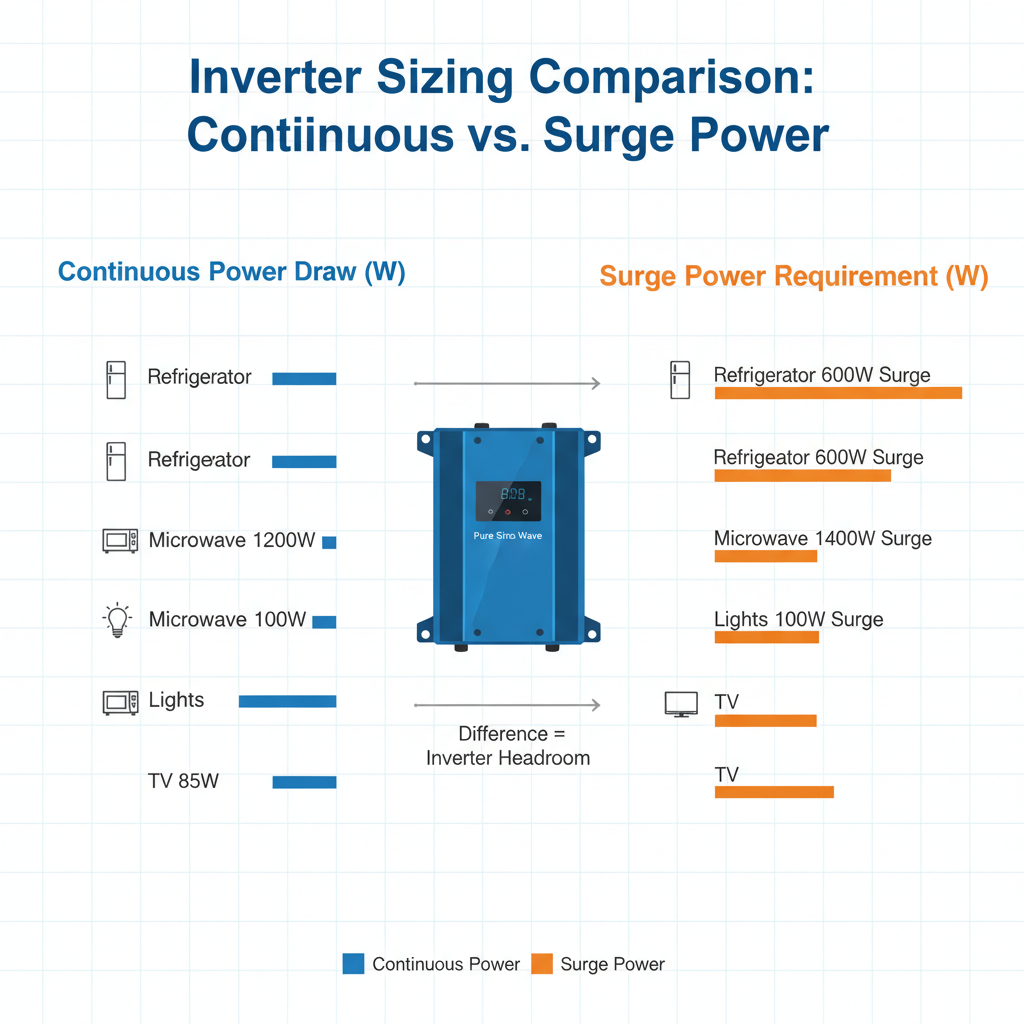
Your refrigerator might run at 150 watts most of the time. But when that compressor kicks in? It wants 600 watts. Right now. No negotiating.
This is why inverter sizing isn’t about adding up nameplate ratings and calling it done. It’s about understanding how your stuff actually behaves in the real world.
Understanding Continuous vs Surge Power
Every inverter has two power ratings. Most people ignore the important one.
Continuous power: What the inverter can output all day long without breaking a sweat.
Surge power: What it can handle for a few seconds when something demanding starts up.
Here’s where it gets interesting. That surge rating? It’s usually double the continuous rating. Sometimes more. But only for 10-20 seconds max.
Your washing machine doesn’t care about your inverter’s feelings. When it starts that spin cycle, it’s going to demand its surge power whether you planned for it or not.
I learned this when my “1000-watt” inverter (which could surge to 2000 watts) couldn’t start my 800-watt circular saw. Turns out that saw needed 2400 watts for about three seconds to get going.
Math is brutal sometimes.
How to Calculate Your Real Power Draw
Forget the nameplate. Time for real measurements.
Get yourself a Kill A Watt meter or similar device. Thirty bucks well spent. Plug your appliances in and watch what actually happens.
Here’s what I found measuring my own stuff:
Kitchen appliances (the surge monsters):
- Microwave: 1200W continuous, 1400W startup
- Coffee maker: 900W continuous, 1800W startup
- Toaster: 1000W continuous, 1200W startup
Motors (the real problem children):
- Refrigerator: 150W running, 600W startup
- Washing machine: 400W running, 2200W startup
- Circular saw: 800W running, 2400W startup
Electronics (the well-behaved ones):
- TV: 85W continuous, 90W startup
- Laptop charger: 65W continuous, 70W startup
- LED lights: Exactly what the package says
Notice the pattern? Motors are jerks. Electronics are polite. Kitchen appliances are somewhere in between.
This is why you can’t just look at your power needs calculation and pick an inverter. You need the whole story.
The Appliance Categories That’ll Bite You
Some appliances are predictable. Others are lying to your face.
Resistive loads (honest appliances): Space heaters, incandescent bulbs, electric kettles. What you see is what you get. If it says 1500 watts, it uses 1500 watts. No surprises.
Inductive loads (the troublemakers): Anything with a motor. Refrigerators, power tools, washing machines. These need 2-4 times their running power to start up.
Capacitive loads (the weird ones): Switch-mode power supplies, some LED drivers. They can have power factor issues that make your inverter work harder than expected.
Pro tip: If it has a motor, assume it’s going to be difficult. Plan accordingly.
Sizing Your Inverter: The Real Formula
Here’s how to actually size an inverter without guessing:
Step 1: List everything you might run simultaneously. Be honest. You’re not running your microwave, washing machine, and circular saw at the same time. But you might run your fridge, lights, and TV together.
Step 2: Find the highest surge requirement in your simultaneous-use list. This is your minimum surge rating.
Step 3: Add up the continuous power for everything you identified in step 1. This is your minimum continuous rating.
Step 4: Add 20% buffer to both numbers. Because Murphy’s Law is real, and you’ll think of something else you want to plug in.
Example: My RV setup runs a fridge (150W continuous, 600W surge), LED lights (100W total), TV (85W), and occasionally the microwave (1200W, 1400W surge).
Simultaneous continuous load: 150 + 100 + 85 = 335W
Highest surge: 1400W (microwave)
With 20% buffer: 402W continuous, 1680W surge
So I need at least a 500W continuous inverter that can surge to 1700W+. A 1000W inverter with 2000W surge capacity handles this comfortably.
This connects back to your overall system sizing calculations – your inverter needs to match not just your battery capacity, but your actual usage patterns.
Pure Sine Wave vs Modified Sine Wave
Here’s where people get religious about inverters. Let me cut through the noise.
Modified sine wave inverters: Cheaper, work fine for resistive loads, might make motors run hot, can cause weird behavior in sensitive electronics.
Pure sine wave inverters: More expensive, work with everything, motors run cooler, no weird electronic behavior.
My take? If you’re powering anything with a motor or any modern electronics, go pure sine wave. The price difference isn’t worth the headaches.
I tried to save $50 with a modified sine wave inverter once. My CPAP machine sounded like a dying robot. Some lessons cost money.
Common Inverter Sizing Mistakes
I’ve made most of these. You don’t have to.
Mistake 1: Adding up all your appliance nameplates without considering simultaneous use. Nobody runs everything at once.
Mistake 2: Ignoring surge requirements. Your inverter will shut down or damage itself trying to start that motor.
Mistake 3: Buying way too much inverter “just in case.” A 3000W inverter is less efficient at light loads than a properly sized 1000W unit.
Mistake 4: Not considering your battery bank capacity. A huge inverter on a small battery bank is like putting a fire hose on a water balloon.
Mistake 5: Forgetting about DC-side current draw. That 1000W inverter pulls about 90 amps from your 12V battery bank. Make sure your wiring can handle it.
Inverter Efficiency: The Hidden Power Tax
Every inverter steals some power for itself. It’s the cost of doing business.
Good inverters are 90-95% efficient at rated load. That means your 1000W load actually draws 1050-1110W from your batteries.
But here’s the kicker: efficiency drops at light loads. That same inverter might only be 80% efficient at 100W load. Your 100W load now costs 125W from the battery.
This is why inverter sizing matters for efficiency too. A properly sized inverter runs in its sweet spot more often.
Putting It All Together: Your Inverter Shopping List
When you’re ready to buy, here’s your checklist:
✓ Continuous power rating covers your simultaneous loads + 20%
✓ Surge power rating covers your highest surge requirement + 20%
✓ Pure sine wave output
✓ Efficiency rating above 90% at rated load
✓ Low-power standby mode (under 20W idle draw)
✓ Protection features: over-temperature, over-load, low-voltage shutdown
✓ Remote control capability (nice to have)
Don’t forget to factor inverter sizing into your broader system planning. This connects directly to your battery bank capacity and charging requirements.
The Bottom Line on Inverter Sizing
Good inverter sizing isn’t about buying the biggest one you can afford. It’s about matching your real power draw with the right amount of headroom for surge loads.
Measure your actual loads. Plan for surge requirements. Add a reasonable buffer. Buy quality.
Your future self will thank you when everything just works, instead of spending weekends troubleshooting why your microwave won’t start or your refrigerator sounds angry.
Trust me on this one. I learned it the hard way so you don’t have to.