
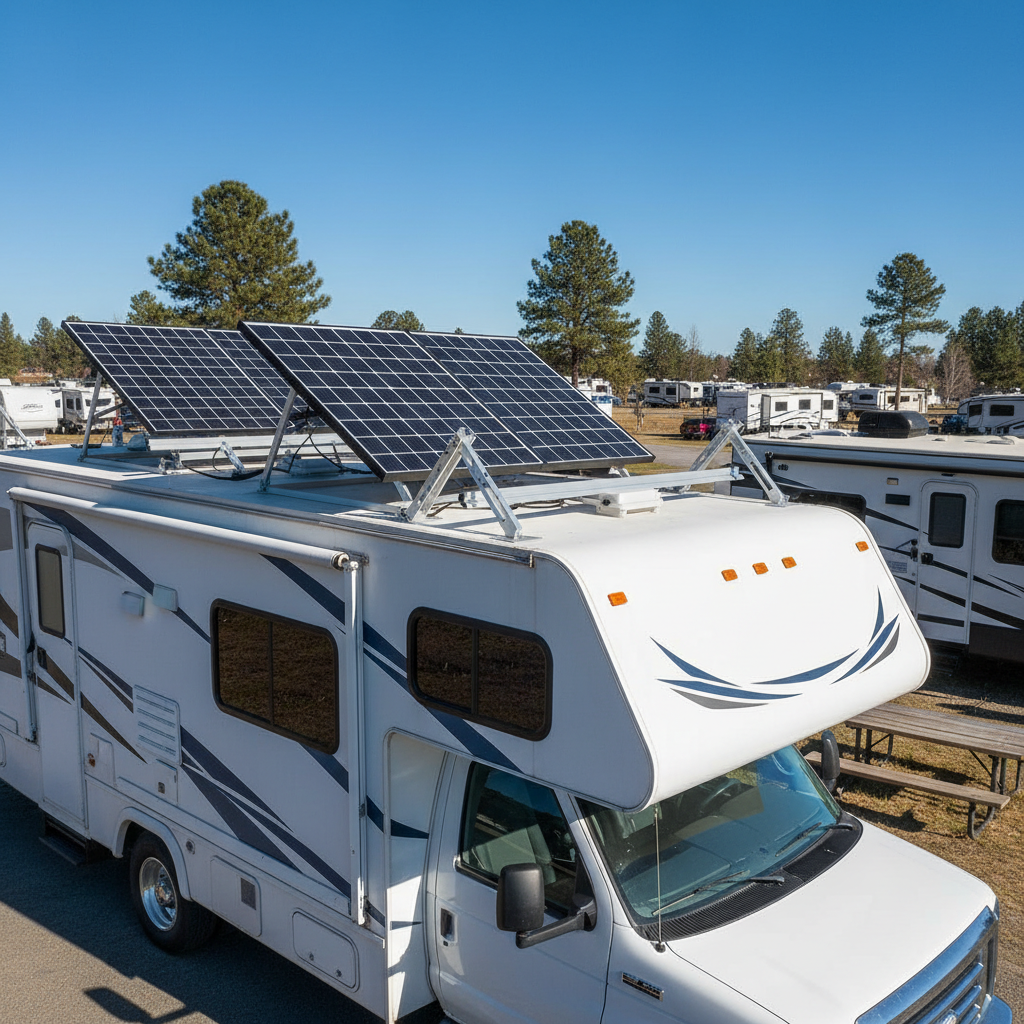
RV solar tilt brackets promise to boost your power output by 30% or more. Sounds amazing, right? I thought so too when I dropped $400 on fancy adjustable mounts for my RV. Spoiler alert: the math doesn’t always work out the way you’d hope.
Here’s the reality check nobody talks about. Those impressive power gains only happen under perfect conditions. And perfect conditions don’t happen often when you’re actually camping.
Let me save you from my expensive mistake and show you when tilt brackets make sense – and when they’re just shiny money drains.
What Are RV Solar Tilt Brackets Really?
Tilt brackets are adjustable mounting systems that let you angle your solar panels toward the sun. Instead of lying flat on your roof, panels can tilt anywhere from 0 to 90 degrees.
The theory is solid. Solar panels work best when they’re perpendicular to the sun’s rays. Your RV roof? Not so much. It’s usually flat or slightly angled, which means your panels aren’t optimally positioned most of the time.
But here’s where marketing meets reality. Those 30% power gains assume you’re constantly adjusting your panels throughout the day. And that you’re camping in wide-open spaces with zero shade.
The Math Behind Solar Panel Tilt
Let’s crunch some actual numbers. I don’t have an engineering degree either, but basic trigonometry doesn’t lie.
A 100-watt panel produces its rated power at standard test conditions: perpendicular to the sun with specific irradiance levels. When your panel is flat and the sun is at a 45-degree angle, you lose about 30% of that power due to the cosine effect.
Tilt your panel to match the sun’s angle, and boom – you get that power back. The math works.
But here’s the catch: optimal tilt angle changes throughout the day. In summer, you want less tilt. In winter, more. Unless you’re adjusting constantly, you’re not getting maximum benefit.
Most RVers adjust their panels maybe twice a day. Morning and afternoon. That’s still better than flat mounting, but nowhere near the theoretical maximum.
Real-World Power Gains
After testing my setup for six months, here’s what I actually saw:
Spring/Fall camping: 15-20% average increase over flat mounting. Not bad, but not the promised 30%.
Summer camping: 8-12% increase. The sun is higher, so flat panels work better anyway.
Winter camping: 25-30% increase. This is where tilt brackets really shine. Low winter sun means huge gains from tilting.
Your mileage will vary based on your actual power needs and camping style.
When RV Solar Tilt Brackets Make Sense
Don’t get me wrong – tilt brackets aren’t always a waste. They make perfect sense in specific situations.
You’re a snowbird who camps in sunny, open areas during winter months. Low sun angles mean massive gains from tilting. I’ve seen 40% improvements in December camping.
You boondock for weeks at a time in one location. If you’re not moving every few days, you have time to optimize panel angles. The effort pays off over longer stays.
You have limited roof space for panels. When you can only fit 200 watts on your roof, squeezing every watt matters. Tilt brackets help maximize your limited solar capacity.
You enjoy the technical aspect and don’t mind adjusting panels multiple times per day. Some RVers love optimizing their systems. If that’s you, go for it.
The Money Question
Quality tilt brackets cost $100-200 per panel. Cheap ones break quickly – trust me on this one.
Let’s say you have two 100-watt panels. Quality tilt brackets will cost $300-400. For that money, you could buy another 100-watt panel and flat-mount it instead.
Which gives you more power? Usually the extra panel wins. Plus, you get redundancy if one panel fails.
Do the math for your specific situation before buying fancy hardware.
When to Skip the Tilt Brackets
Most RVers should probably skip tilt brackets. Here’s when they definitely don’t make sense.
You move campsites every 1-2 days. Constantly adjusting panels gets old fast. I lasted about three weeks before I stopped optimizing daily.
You mostly camp in forested or shaded areas. If you’re dealing with shade issues, panel positioning matters less than understanding how shade affects your system.
You have plenty of roof space for more panels. Adding capacity beats optimizing angles every time.
You’re not comfortable with mechanical adjustments. Tilt brackets have moving parts that can break. They also create more wind resistance and potential leak points.
Your RV roof can’t handle the extra weight and wind load. Tilt brackets create significant uplift forces in windy conditions.
The Convenience Factor
Nobody talks about this, but convenience matters more than efficiency for most RVers.
Flat-mounted panels are set-and-forget. Park your RV and you’re done. No adjustments, no thinking about optimal angles, no getting on your roof multiple times per day.
Tilt brackets require constant attention. Is the extra 10-15% power worth climbing on your roof twice daily? That depends on your personality and physical capabilities.
Alternative Solutions That Work Better
Before spending money on tilt brackets, consider these alternatives.
Portable solar panels give you ultimate flexibility. Set them up wherever the sun is strongest, regardless of where you park. No roof modifications required.
More fixed panels often beat fewer tilting panels. Math is simple: 300 watts flat usually produces more than 200 watts with perfect tilting.
Better charge controllers make a bigger difference than tilt brackets. If you’re still using PWM controllers, upgrade to MPPT first.
Efficient battery systems matter more than perfect panel angles. Lithium batteries charge faster and waste less energy than lead-acid alternatives.
The Hybrid Approach
Here’s what I wish I’d done from the start: hybrid mounting.
Mount most panels flat for convenience and reliability. Add one or two portable panels for optimization when you need extra power.
This gives you the best of both worlds. Reliable base power plus the flexibility to maximize production when conditions are perfect.
Total cost is often less than a full tilt bracket setup, and you get more versatility.
Making the Right Decision for Your RV
Tilt brackets aren’t inherently good or bad – they’re tools that work in specific situations.
Ask yourself these questions: Do you camp in the same spot for weeks? Are you comfortable adjusting panels daily? Do you need every possible watt from limited roof space?
If you answered yes to all three, tilt brackets might make sense. If not, you’re probably better off spending that money on more panels or better system components.
Remember, the goal isn’t maximum theoretical efficiency. It’s reliable power for your actual camping lifestyle.
Most RVers are happier with simple, reliable systems that work without constant attention. But if you’re the type who enjoys optimizing every detail, tilt brackets can be a fun and worthwhile upgrade.
The choice is yours – just make it based on math and reality, not marketing promises.