
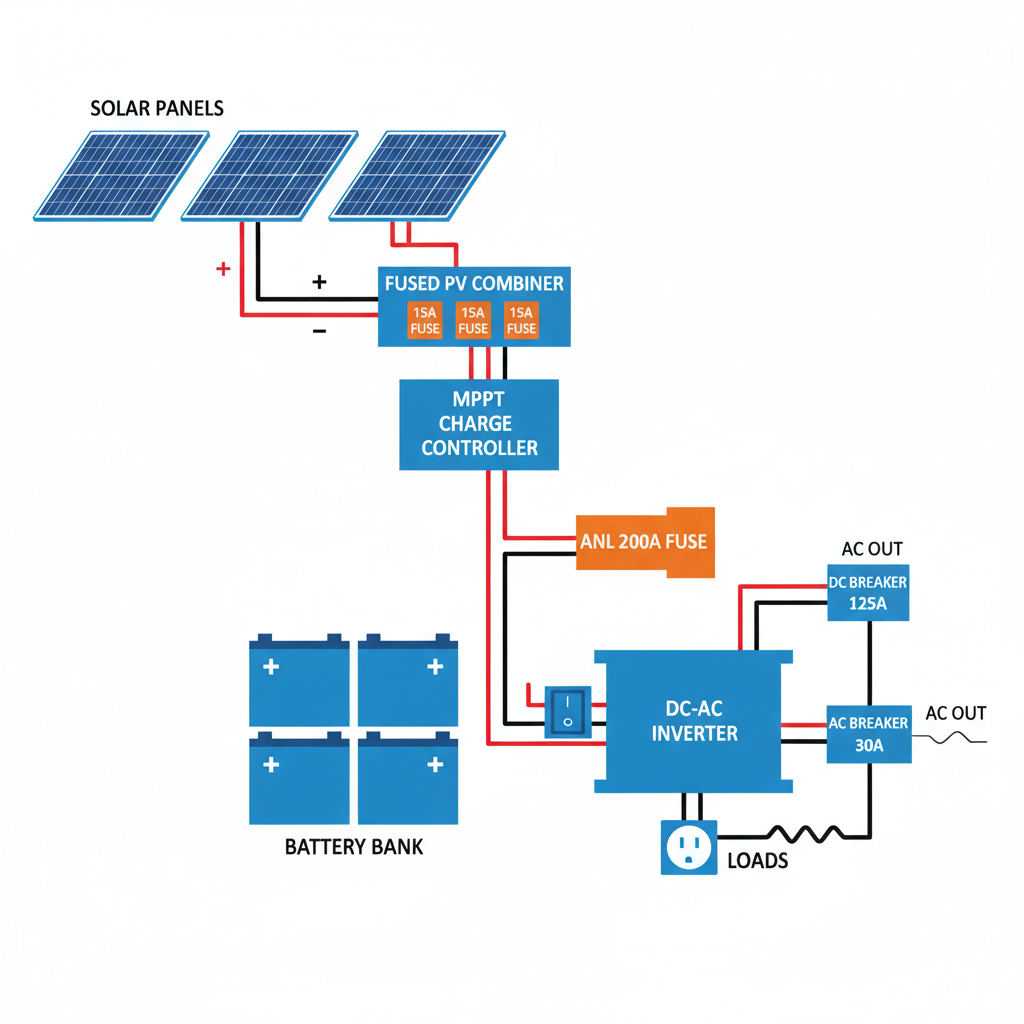
When you’re setting up your DIY solar system, solar fuse protection is absolutely critical for keeping your investment and family safe. Think of fuses and breakers as the security guards of your electrical system – they’re always watching for trouble and ready to shut things down before damage occurs.
Whether you’re installing panels on your RV or setting up a home backup system, understanding electrical protection will save you from costly mistakes and potentially dangerous situations. Let’s dive into everything you need to know about protecting your solar setup the right way.
Why Solar Fuse Protection Matters More Than You Think
Your solar system generates DC power, which behaves differently than the AC power in your home. DC current doesn’t naturally “zero out” like AC does, making it harder to interrupt when something goes wrong. This means that without proper protection, a fault in your system could continue indefinitely.
Here’s what can happen without adequate protection:
- Wire overheating leading to fires
- Equipment damage from overcurrent
- Battery explosions from charging faults
- Inverter burnout from reverse current
The good news? Proper fuse and breaker placement prevents all these scenarios. Moreover, most insurance companies require adequate electrical protection for coverage.
Understanding Fuse Types and Ratings for Solar Systems
Not all fuses are created equal, especially when it comes to solar applications. DC fuses must handle different characteristics than AC fuses, particularly the arc that forms when interrupting current.
DC-Rated Fuses
Always use DC-rated fuses in your solar system. These fuses are specifically designed to handle direct current and can safely interrupt DC arcs. Look for fuses rated at least 125% of your system’s maximum current.
Common Solar Fuse Types:
- ANL fuses: Great for battery connections (40-300 amps)
- Class T fuses: Excellent for inverter protection (110-600 amps)
- Blade fuses: Perfect for smaller loads (5-40 amps)
- NH fuses: Industrial-grade option for large systems
For example, if your solar panel sizing calculations show you need 30 amps, you’d select a 40-amp fuse (30 × 1.25 = 37.5, round up to 40).
Circuit Breaker Placement: Where Protection Counts Most
Circuit breakers offer the convenience of resetting without replacement, but they must be properly placed to be effective. Think of your solar system as having several “zones” that each need protection.
Essential Protection Points:
Between solar panels and charge controller – This protects your controller from panel overcurrent. Place a breaker sized at 125% of your panel’s short-circuit current rating.
Between charge controller and batteries – Critical for preventing battery overcharge damage. Size this based on your controller’s maximum output current.
Between batteries and inverter – Your largest protection point, typically. This prevents damage from inverter faults or shorts.
On AC output loads – Protects individual circuits just like in your home’s electrical panel.
Remember, if you’ve followed proper solar wiring practices, your system should rarely trip these breakers. They’re insurance, not regular operating devices.
Creating Your Simple Solar Fuse Protection Plan
Building an effective protection plan doesn’t require an engineering degree. Start by mapping your system’s current flow and identifying critical protection points.
Step 1: Calculate Your Currents
First, determine the maximum current at each point in your system. Your panels will list their short-circuit current (Isc). Your charge controller specs show maximum output. Your inverter manual provides input current requirements.
Step 2: Apply the 125% Rule
National Electrical Code requires sizing protective devices at 125% of continuous current. This accounts for temperature variations and component tolerances. So if your calculated current is 20 amps, use a 25-amp protective device.
Step 3: Choose Your Devices
Fuses work great for locations you rarely access, like between panels and controllers. Breakers make sense where you might need to disconnect for maintenance, such as battery connections.
Additionally, always install a main disconnect breaker that can shut off your entire system. This is crucial for emergency situations and maintenance work.
Common Protection Mistakes That Could Cost You
Even experienced DIYers make protection errors that can be expensive. Here are the most common mistakes I see:
Using AC-rated devices for DC applications. AC breakers and fuses aren’t designed for DC current interruption. They may not trip properly or could even fail catastrophically.
Undersizing protection devices. A 30-amp fuse on a 35-amp circuit won’t protect anything – it’ll just blow unnecessarily or fail to protect when needed.
Oversizing protection devices. Conversely, a 50-amp fuse on a 20-amp wire creates a fire hazard. The wire will overheat long before the fuse blows.
Skipping battery protection. Batteries can deliver enormous current during faults. Without proper protection, battery shorts can create spectacular and dangerous failures.
Furthermore, many people forget to protect both positive and negative DC conductors when required by code.
Maintenance and Testing Your Solar Fuse Protection
Installing protection is just the first step. Regular maintenance ensures your safety systems work when needed. Think of this like testing smoke detectors – critical but often overlooked.
Check all connections quarterly for signs of heating, corrosion, or loosening. Loose connections create resistance, which generates heat and can cause failures. Look for discoloration, melting, or burning smells.
Test breakers annually by operating them manually. They should trip and reset smoothly. If a breaker feels sticky or won’t reset properly, replace it immediately.
Keep spare fuses on hand, especially for critical circuits. However, if a fuse blows repeatedly, don’t just replace it – find and fix the underlying problem first.
Document your protection scheme and keep records of any trips or blown fuses. Patterns can reveal developing problems before they become serious.
Sizing Protection for Different System Components
Different parts of your solar system have unique protection requirements. Let’s break down the specifics for each major component.
Solar Panel Protection
Individual panels rarely need protection, but panel strings do. Size protection at 125% of the string’s short-circuit current. For most residential panels, this works out to 15-20 amp protection per string.
Battery Bank Protection
Battery protection is arguably the most critical. Lead-acid batteries can deliver hundreds of amps during a short circuit. Size your main battery fuse or breaker based on your inverter’s maximum input current, typically 125-400 amps for home systems.
If you’re following proper battery maintenance practices, your protection devices should rarely activate. However, they’re essential insurance against catastrophic failure.
Inverter Protection
Inverters need both DC input protection and AC output protection. The DC side protects against battery overcurrent, while the AC side protects your loads and meets electrical code requirements.
Advanced Protection Features Worth Considering
While basic fuses and breakers handle most protection needs, some advanced features can enhance system safety and performance.
Ground Fault Protection
Ground fault circuit interrupters (GFCIs) detect current leakage to ground and shut off power immediately. They’re required by code in many solar installations and provide excellent protection against electrocution.
Arc Fault Protection
Arc fault circuit interrupters (AFCIs) detect dangerous arcing conditions that could start fires. While not always required for DC systems, they’re becoming more common and provide additional safety.
Remote Monitoring
Some modern breakers and fuses include remote monitoring capabilities. These systems can alert you to trips or problems via smartphone apps, helping you address issues quickly.
Finally, consider surge protection devices (SPDs) to protect against lightning and voltage spikes. While not technically overcurrent protection, they’re an important part of a comprehensive safety plan.
Remember, solar fuse protection isn’t just about meeting code requirements – it’s about protecting your investment and keeping your family safe. Take the time to design and install proper protection, and your solar system will serve you reliably for decades to come.