
Let me guess—you’ve read that solar panel orientation should always face south for maximum power generation. Then you looked at your roof and realized your house faces the ‘wrong’ direction. Welcome to reality, where perfect doesn’t always happen.
I made this same mistake early on. Spent weeks obsessing over magnetic declination and true south calculations, only to discover that ‘sub-optimal’ directions aren’t nearly as bad as the internet makes them sound.
Here’s what actually happens when you point your panels east, west, or that magical south direction. Spoiler alert: you might not need to redesign your house.
The South-Facing Solar Panel Orientation Myth
Yes, south-facing panels produce the most total energy over a full day. They’re the benchmark—100% efficiency if you will.
But ‘most energy’ and ‘best for your situation’ aren’t always the same thing. I learned this the hard way after installing my first system.
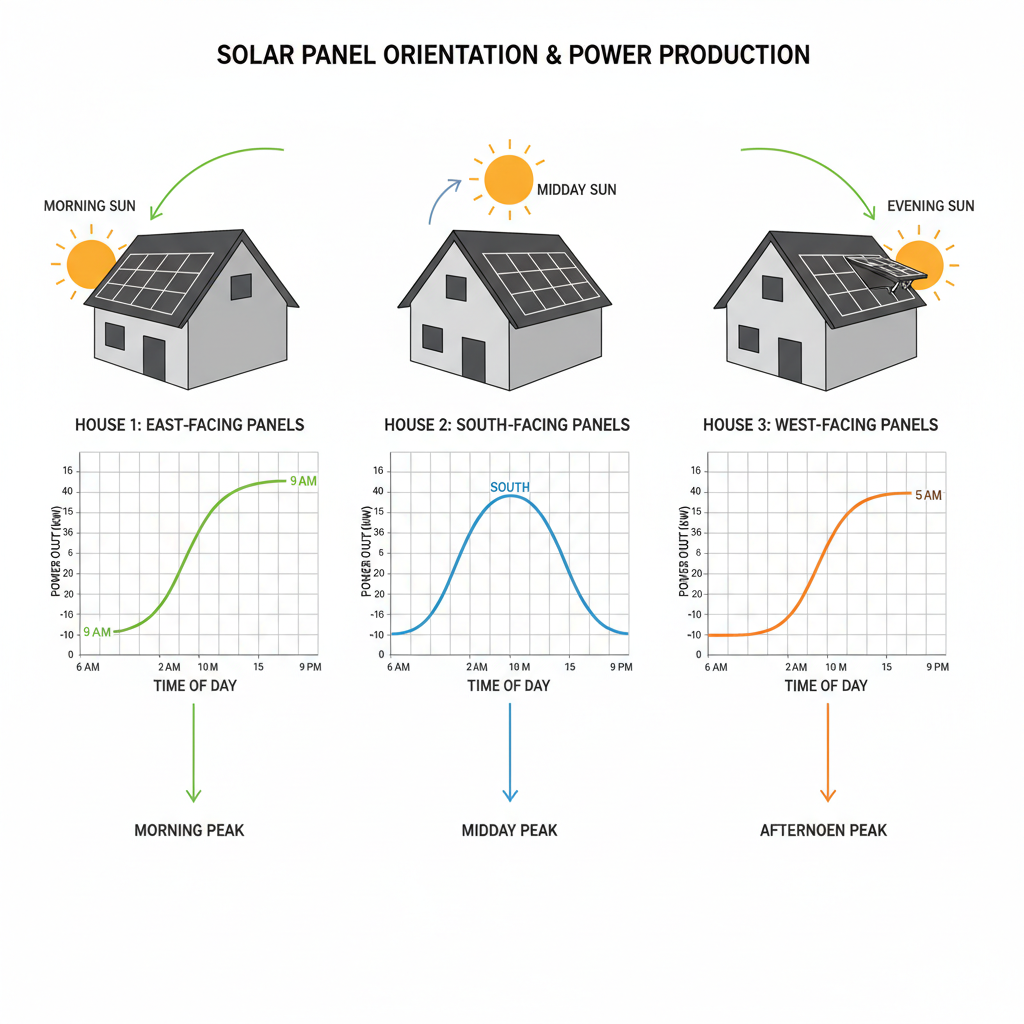
South-facing panels generate peak power from about 10 AM to 2 PM. Great if you use most of your electricity during lunch. Not so great if you’re like most people who need power in the morning and evening.
The dirty secret nobody talks about? Peak solar production often happens when you need the least electricity.
East-Facing Solar Panel Orientation: The Morning Champion
East-facing panels typically produce about 85-90% of the energy that south-facing panels generate. Not terrible, right?
But here’s where it gets interesting. East panels start producing power earlier—around 6 AM instead of 8 AM. They hit their peak around 9-10 AM, then taper off by mid-afternoon.
This timing actually matches human schedules better. Think about it:
- Coffee makers and breakfast routines
- Getting ready for work
- Morning device charging
- Air conditioning in hot climates (yes, some places need AC in the morning)
I tested this on my own system. My east-facing panels produced 18% more power between 6-10 AM compared to my south-facing array. The total daily production was lower, but the timing was perfect.
Real East-Facing Numbers
Here’s actual data from a 3kW east-facing system over a full year:
- Total annual production: 3,400 kWh
- South-facing equivalent: 3,800 kWh
- Morning hours (6-10 AM): 35% of daily production
- Afternoon hours (2-6 PM): 15% of daily production
The 400 kWh difference? That’s about $50-80 per year in most areas. Hardly worth losing sleep over.
West-Facing Solar Panels: The Evening Powerhouse
West-facing panels also produce about 85-90% of south-facing output. But their power curve is completely different from east-facing systems.
These panels start slow—barely producing anything before 10 AM. But they keep going strong until sunset, with peak production from 1-4 PM.
West orientation shines (literally) for:
- After-work power needs
- Evening cooking and dinner prep
- Prime time TV and electronics
- Late afternoon air conditioning loads
Plus, west-facing panels often deal with less morning dew and frost, which can slightly improve performance in some climates.
However, there’s a catch. West-facing panels get the hottest afternoon sun, which actually reduces efficiency. Solar panels lose about 0.4% efficiency for every degree above 77°F (25°C).
Still, for most residential users, west-facing timing beats south-facing total production.
What About North-Facing Panels?
Don’t. Just don’t.
North-facing panels produce maybe 60-70% of south-facing output. That’s getting into ‘maybe not worth it’ territory unless you have no other options.
The only exception? If you live in the southern hemisphere. Then north is your south, obviously.
Time-of-Use Rates Change Everything
Here’s where solar panel orientation strategy gets really interesting. Many utilities now use time-of-use (TOU) billing.
Under TOU rates, electricity costs more during peak demand hours (usually 4-9 PM). Guess which panel orientation produces power during expensive evening hours?
West-facing panels can actually generate more value than south-facing panels, even with lower total production. I’ve seen cases where west-facing systems save 15-20% more money annually despite producing 10% less power.
Before choosing your orientation, check if your utility uses TOU rates. This single factor might flip your entire strategy.
The Split-Array Solution
Can’t decide? Do both.
Split arrays—half east-facing, half west-facing—smooth out your production curve. You get morning power from the east array and afternoon power from the west array.
Total production usually matches south-facing systems while providing better load matching. It’s like having a longer, flatter power curve instead of a sharp midday peak.
The downsides? More complex wiring and potentially higher installation costs. You’ll also need to consider different wire gauge calculations for each array.
But for many homes, split arrays are the sweet spot between production and practicality.
Seasonal Changes Matter Too
Solar panel orientation affects seasonal performance differently. South-facing panels maintain relatively consistent output year-round (adjusted for daylight hours).
East and west-facing panels show more seasonal variation:
- Summer: West panels slightly outperform east panels
- Winter: East panels slightly outperform west panels
- Spring/Fall: Nearly equal performance
This happens because the sun’s path changes throughout the year. In summer, the sun rises further north and sets further north, favoring west-facing panels slightly. Winter reverses this pattern.
The differences are small—maybe 5-10% seasonal swing. But it’s worth knowing if you’re trying to optimize for specific times of year.
Your Roof Might Decide For You
Theory is nice. Reality is what matters.
Your roof orientation, shading, and structural limitations often make the decision for you. Don’t fight your house just to chase perfect south-facing orientation.
A well-installed east or west-facing system beats a poorly executed south-facing system every time. Focus on what works with your specific situation.
Before you start planning, do a proper shade analysis of your property. Shading trumps orientation every single time.
The Bottom Line on Solar Panel Orientation
South-facing panels produce the most total energy. But east and west-facing panels often provide better value by matching your actual usage patterns.
Here’s my practical advice:
- South-facing: Choose if you have time-of-use rates with cheap midday electricity
- East-facing: Best for morning power needs and most residential users
- West-facing: Ideal if you have expensive evening electricity rates
- Split array: Consider if you have roof space on multiple orientations
The 10-15% production difference between orientations usually matters less than proper system sizing and quality installation.
Don’t let perfect orientation paralysis stop you from going solar. An installed system facing the ‘wrong’ direction beats a perfect system that never gets built.
Your electricity bill doesn’t care about textbook efficiency. It only cares about the power you actually generate when you need it most.