
I learned about battery bank wiring the expensive way – by destroying a perfectly good lithium battery because I mixed series and parallel connections like some kind of electrical mad scientist. Don’t be me. Let’s figure out when to wire batteries in series, when to go parallel, and how to avoid turning your battery bank into an expensive paperweight.
Series vs Parallel Wiring: The Core Difference
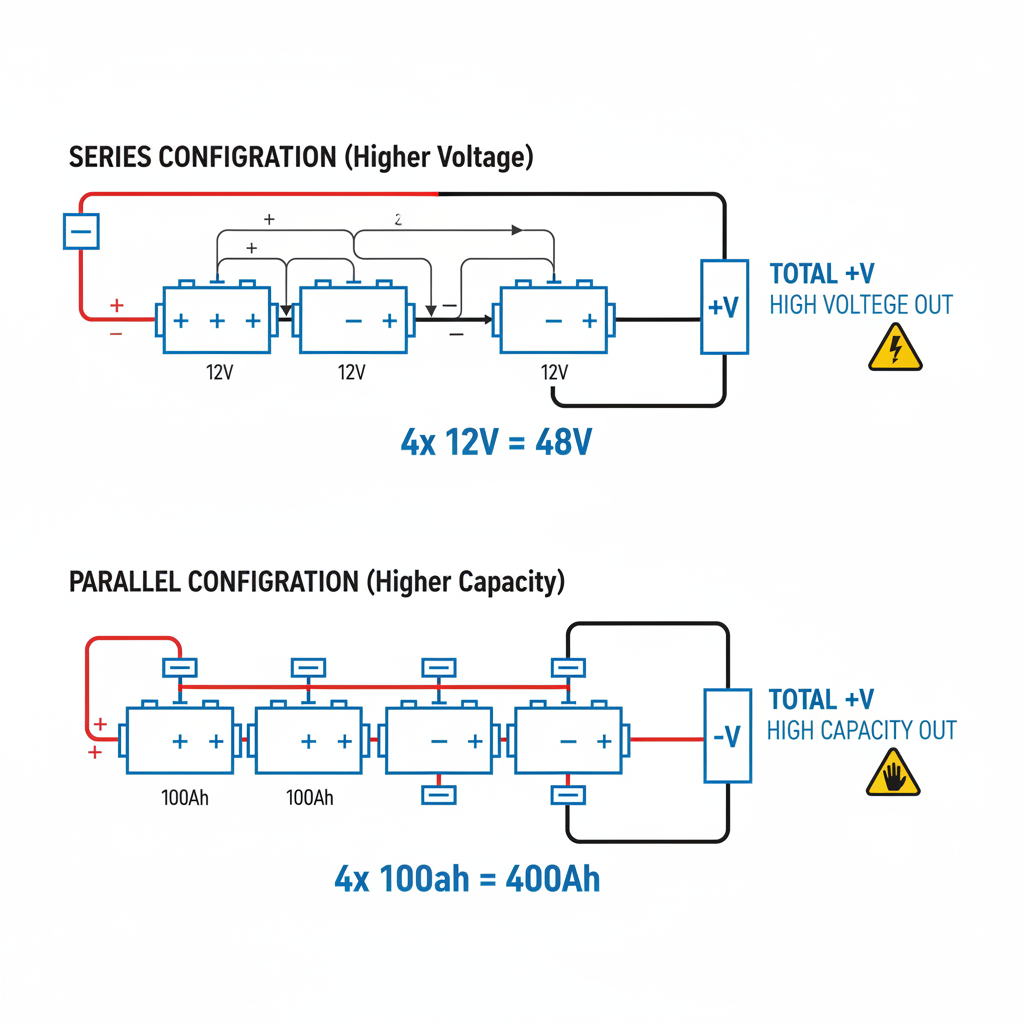
Series wiring connects batteries end-to-end, adding voltage. Parallel wiring connects batteries side-by-side, adding capacity. That’s it. The rest is just avoiding the ways this can go spectacularly wrong.
In series, you connect the positive terminal of one battery to the negative terminal of the next. Two 12V batteries in series give you 24V. The capacity stays the same as one battery.
In parallel, you connect all positive terminals together and all negative terminals together. Two 12V batteries in parallel still give you 12V. But now you’ve doubled your amp-hour capacity.
When to Use Series Battery Bank Wiring
Use series wiring when you need higher voltage for your system. Most commonly, this means:
• 24V or 48V home systems that need higher voltage for efficiency
• RV systems where you want to reduce current flow (smaller wires)
• When your inverter requires a specific voltage input
Higher voltage systems are more efficient because they move the same power with less current. Less current means less heat, smaller wires, and fewer voltage drop headaches. If you’ve been wrestling with solar voltage drop calculations, higher voltage is often your friend.
When to Use Parallel Wiring
Parallel wiring makes sense when you need more runtime at your existing voltage:
• Adding capacity to a 12V RV system
• Building a larger battery bank without changing your inverter
• When you want redundancy (one battery fails, others keep working)
Most DIY solar folks start with parallel because it’s conceptually simpler. Your system voltage stays the same, you just get more juice.
The Voltage Mismatch Problem That Kills Batteries
Here’s where battery bank wiring gets dangerous. Mix different battery types, ages, or states of charge, and you create voltage mismatches that destroy batteries faster than leaving your RV fridge on for a week.
In series, voltage mismatches cause one battery to overcharge while another stays undercharged. The weak battery becomes the bottleneck for your entire string.
In parallel, higher voltage batteries dump current into lower voltage ones. This creates heat, reduces lifespan, and can trigger thermal runaway in lithium batteries.
How to Match Batteries Properly
Use identical batteries. Same brand, same model, same age, same state of charge. I know it’s boring advice, but mixing battery types is like mixing oil and water – technically possible, practically stupid.
If you’re upgrading an existing bank, replace all batteries at once. Your new battery will either be dragged down by the old ones or destroy them trying to equalize voltages.
Before connecting, charge each battery to the same voltage. A 0.1V difference between batteries might not sound like much, but it’ll cause current flows that shorten lifespan.
Series-Parallel Combinations (Where Things Get Spicy)
You can combine series and parallel wiring to get both higher voltage and more capacity. This is where most people create electrical chaos.
The key is building identical strings first, then connecting those strings in parallel. Four batteries can become two series strings of two batteries each, then those strings connected in parallel.
Each string must have identical voltage. If one string reads 24.5V and another reads 24.2V, you’ve created a current loop that’ll age your batteries like stress ages humans.
Balancing Current Flow
Use identical wire lengths for each string. Different wire lengths create different resistances, causing uneven current distribution. The string with shorter wires carries more load and dies first.
This is where understanding proper wire sizing becomes critical. Undersized wires create voltage drops that throw off your carefully balanced system.
Safety Rules That Prevent Fire Hazards
Wiring multiple batteries creates more stored energy and higher current capabilities. That means more ways for things to catch fire if you screw up.
Install fuses on every positive connection. Not just the main positive – every single positive wire in your battery bank wiring needs overcurrent protection. A short circuit in an unfused wire can melt copper and start fires.
Use proper battery terminals and connections. Those cheap wing nut terminals from the hardware store aren’t designed for high current. Loose connections create heat, heat creates resistance, resistance creates more heat.
Understanding proper solar fusing isn’t optional when you’re dealing with multiple batteries. More stored energy means more potential for spectacular failures.
Wire Management and Strain Relief
Secure all wiring so vibration can’t create loose connections. This is especially important in RV installations where everything shakes constantly.
Use strain relief boots on battery terminals. Battery posts aren’t designed to support wire weight, and a broken post on a lithium battery can be an expensive lesson in physics.
Testing Your Battery Bank Configuration
Before connecting your battery bank to anything else, test it with a multimeter. Measure voltage across the entire bank and between individual batteries.
All batteries in a parallel bank should read identical voltages. Any difference indicates a problem – either mismatched batteries or poor connections.
In series banks, voltages should add up correctly. Two 12V batteries should give you 24V, not 23.8V or 24.3V.
Load test your bank before trusting it with your system. Connect a known load and verify current flows as expected. Proper load testing techniques will catch wiring problems before they become expensive problems.
Monitoring Individual Battery Health
Install monitoring on individual batteries, not just the bank as a whole. A failing battery can drag down an entire series string or create hot spots in parallel configurations.
Battery monitors that track individual cell voltages are worth the investment for larger banks. They’ll alert you to problems before batteries start swelling or smoking.
Common Wiring Mistakes That Cost Money
Don’t daisy-chain connections. Instead of connecting battery 1 to battery 2 to battery 3, run separate wires from a central point to each battery. This distributes current more evenly.
Avoid mixing battery chemistries. AGM and lithium have different charging profiles and voltage curves. Connecting them is like asking a marathon runner and a sprinter to hold hands during a race.
If you’re still deciding between battery types, check out our AGM vs lithium comparison before wiring anything permanently.
Don’t ignore temperature differences. Batteries in hot locations age faster and can create voltage imbalances in your bank. Keep battery temperatures as uniform as possible.
Sizing Your Battery Bank Correctly
Before worrying about wiring configuration, make sure you actually need multiple batteries. A single larger battery is often more reliable than multiple smaller ones.
Size your bank based on actual energy needs, not just what fits in your available space. Our power needs calculation guide will help you determine realistic capacity requirements.
Consider system voltage early in your planning. It’s easier to design for 24V from the start than to reconfigure a 12V system later.
Future Expansion Planning
Design your wiring to accommodate future expansion. Run larger wire than you currently need and leave space for additional batteries.
Document your battery bank wiring configuration. Trust me, you’ll forget which wire goes where six months from now. A simple diagram saves hours of troubleshooting.
Choose a configuration that matches your skill level. Complex series-parallel banks require more monitoring and maintenance than simple parallel configurations.
Wrapping Up: Keep It Simple, Keep It Safe
Battery bank wiring doesn’t have to be complicated, but it does have to be safe. Start with identical batteries, use proper fusing, and test everything before connecting to your system.
Series increases voltage, parallel increases capacity. Everything else is just avoiding the ways this can go wrong. Match your batteries, balance your connections, and don’t try to get fancy until you’ve mastered the basics.
Your future self will thank you for the boring, safe approach when your battery bank is still working years later instead of being an expensive lesson in what not to do.