
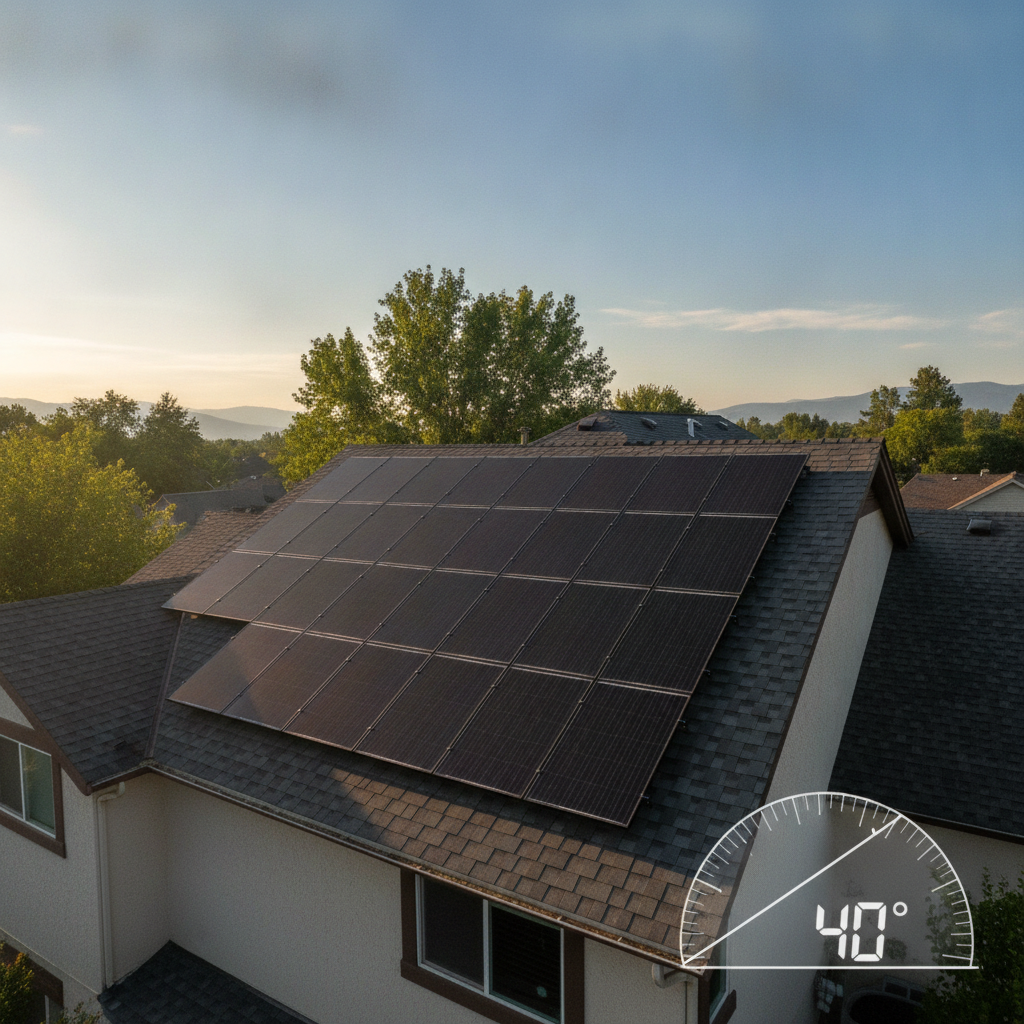
Your Solar Panel Tilt Angle Is Quietly Costing You Power
Most people spend weeks researching solar panels, batteries, and inverters. Then they slap their panels flat on the roof and call it done. The solar panel tilt angle gets zero attention — and it’s one of the easiest performance wins available. No extra panels. No new wiring. Just geometry doing its job.
I did this wrong on my first setup. Flat panels, lots of optimism, mediocre output. Took me an embarrassingly long time to connect the dots. So let’s save you that particular headache.
Why Tilt Angle Actually Matters
Here’s the core idea. The sun doesn’t sit directly overhead for most of us, most of the time. It tracks across the sky at an angle that depends on your location and the time of year. When sunlight hits a panel at a perpendicular angle — straight on — you get maximum output. When it hits at a shallow angle, you lose a chunk of that potential energy.
Think of it like holding a flashlight over a table. Shine it straight down and you get a bright, tight circle. Tilt the flashlight and the light spreads out — same energy, less intensity per square inch. Your panels work exactly the same way.
The difference between a well-tilted array and a poorly tilted one can range from 10% to over 25% in annual production. That’s not a rounding error. That’s real kilowatt-hours you paid for and aren’t getting.
The Relationship Between Tilt and Latitude
Your latitude is the starting point for every tilt angle calculation. The math here is genuinely simple — which is rare in solar, so enjoy it.
For a fixed year-round tilt, start with your latitude. That’s it. If you live at 35° north, tilt your panels at 35°. That single rule gets you surprisingly close to optimal for annual production. It’s not perfect, but it’s a massive upgrade over flat or random guessing.
Here’s a quick reference breakdown:
- Latitude 25° (southern states, southern Spain): Tilt 25°
- Latitude 35° (mid-US, northern Mediterranean): Tilt 35°
- Latitude 45° (northern US, northern Europe): Tilt 45°
- Latitude 51° (UK, Canada): Tilt 51°
Don’t know your latitude? Google your city name plus “latitude.” You’ll have your number in ten seconds.
Fixed Tilt vs Seasonal Adjustments
This is where people start overthinking it. Let me break it down plainly.
Fixed Tilt: Simple and Effective
A fixed tilt set at your latitude is the standard approach for rooftop installations. You set it once. You forget about it. You get solid year-round performance.
For most homeowners with roof-mounted panels, this is exactly what you should do. Roof mounting doesn’t exactly lend itself to twice-yearly angle adjustments. The production gains from seasonal tweaks rarely justify the effort — or the structural gymnastics — on a typical home roof.
If you want to squeeze slightly more annual production from a fixed setup, there’s a small refinement. Because summer produces more sun hours than winter, you can bias your fixed angle slightly toward winter optimization. The rule of thumb: set your fixed tilt at latitude minus 2.5° for a marginally better annual average. The difference is modest, but it’s free.
Seasonal Adjustments: Worth the Effort?
If your panels are on an adjustable ground mount or on an RV, seasonal adjustments are genuinely worthwhile. The numbers look like this:
- Summer tilt: Latitude minus 15°
- Winter tilt: Latitude plus 15°
So if you’re at 40° latitude, you’d use 25° in summer and 55° in winter. That optimization can add another 5–10% to your annual production compared to a fixed angle. Not life-changing, but meaningful if you’re chasing every watt — especially in winter when production is already down.
For RV owners, this is particularly relevant. If you’re running an adjustable tilt bracket system, using these seasonal angles makes a real difference. I covered the specific hardware tradeoffs in detail over at RV Solar Tilt Brackets: 30% Power Boost or Money Pit? — worth reading before you buy anything.
How Your Roof Pitch Complicates Things (And How to Handle It)
Most of us don’t get to pick our roof pitch. Your house already has one. This creates a straightforward problem: what if your roof slope doesn’t match your ideal tilt angle?
First, figure out your actual roof pitch. Most residential roofs in the US fall between 18° and 35°. If your roof pitch happens to be close to your latitude, you’re lucky — just flush-mount and move on.
If your roof is too shallow, you have a few options. Tilt-up mounting hardware can raise your panels to the correct angle. The tradeoff is wind load — tilted panels catch more wind, which matters in storm-prone areas. Check local codes before you assume this is a free upgrade.
If your roof is steeper than your ideal angle, flush mounting is still fine. You’ll lose a little summer production, but steeper angles actually work better in winter and handle snow shedding better. Depending on where you live, that tradeoff might genuinely favor the steeper angle.
Don’t Forget Orientation Too
Tilt angle is only half the story. The direction your panels face — their azimuth — works together with tilt to determine total output. In the northern hemisphere, south-facing is the standard for maximum annual production. East and west both have their use cases, and I broke down those tradeoffs in Solar Panel Orientation: East vs West vs South Reality.
Also worth mentioning: shading interacts with tilt angle in ways that surprise people. A well-tilted panel in partial shade can underperform a flat panel in full sun. Before you optimize your angle, make sure you’ve mapped your actual shade situation. Solar Shade Analysis: Map Your Property’s Sun Zones walks through how to do that properly.
Flat Panels: When Is It Actually Acceptable?
I said flat panels are a mistake. Here’s the asterisk on that statement.
Completely flat — or very low tilt — panels do have specific legitimate use cases. If you’re in a very low latitude location (below 15°), shallow tilts produce surprisingly competitive annual yields because the sun is high overhead most of the year. And some commercial flat rooftops use low-tilt ballasted systems specifically to avoid penetrating the roof membrane.
But for most of us in the 25°–55° latitude band? Flat panels are a performance choice you’re making by default rather than by design. There’s usually a better option available.
Quick Tilt Optimization Checklist
Before you finalize any panel mount, run through this:
- Find your latitude. Google it. Takes ten seconds.
- Set your baseline tilt to match your latitude. Done. You’re already ahead of most DIYers.
- Consider your seasonal priorities. Need more winter power? Increase tilt. Maximizing summer? Decrease tilt.
- Check your roof pitch. Flush mount if it’s close to ideal. Add tilt hardware only if the gap is significant.
- Confirm your orientation. South-facing in the northern hemisphere. Adjust from there based on your specific situation.
- Reassess shading. Optimal tilt means nothing if a tree shades your array for four hours a day.
Tilt Is One Variable in a Bigger Equation
Getting your solar panel tilt angle right is a meaningful win. But it works best when the rest of your system is sized and configured correctly too. If you haven’t already worked through your actual power needs, Solar Panel Sizing: Calculate Your Power Needs Guide is a solid place to start. Tilt optimization on an undersized system is like putting premium gas in a car with a flat tire.
Similarly, your charge controller settings interact with how much power your panels actually deliver. Once your tilt is dialed in, it’s worth reviewing MPPT Controller Settings: 5 That Actually Matter to make sure your controller is harvesting everything your newly optimized array is producing.
The Bottom Line on Solar Panel Tilt Angle
This is one of those rare solar topics where the solution is genuinely simple. Find your latitude. Match your tilt to it. Adjust seasonally if your setup allows. Stop leaving free production on the table.
You don’t need a tracker. You don’t need an engineering degree. You need a protractor, a basic understanding of where you live on the planet, and enough self-awareness to realize that “I just put them flat because it was easier” is not actually a solar strategy.
Your panels are already paid for. The angle is free. Might as well use it correctly.