
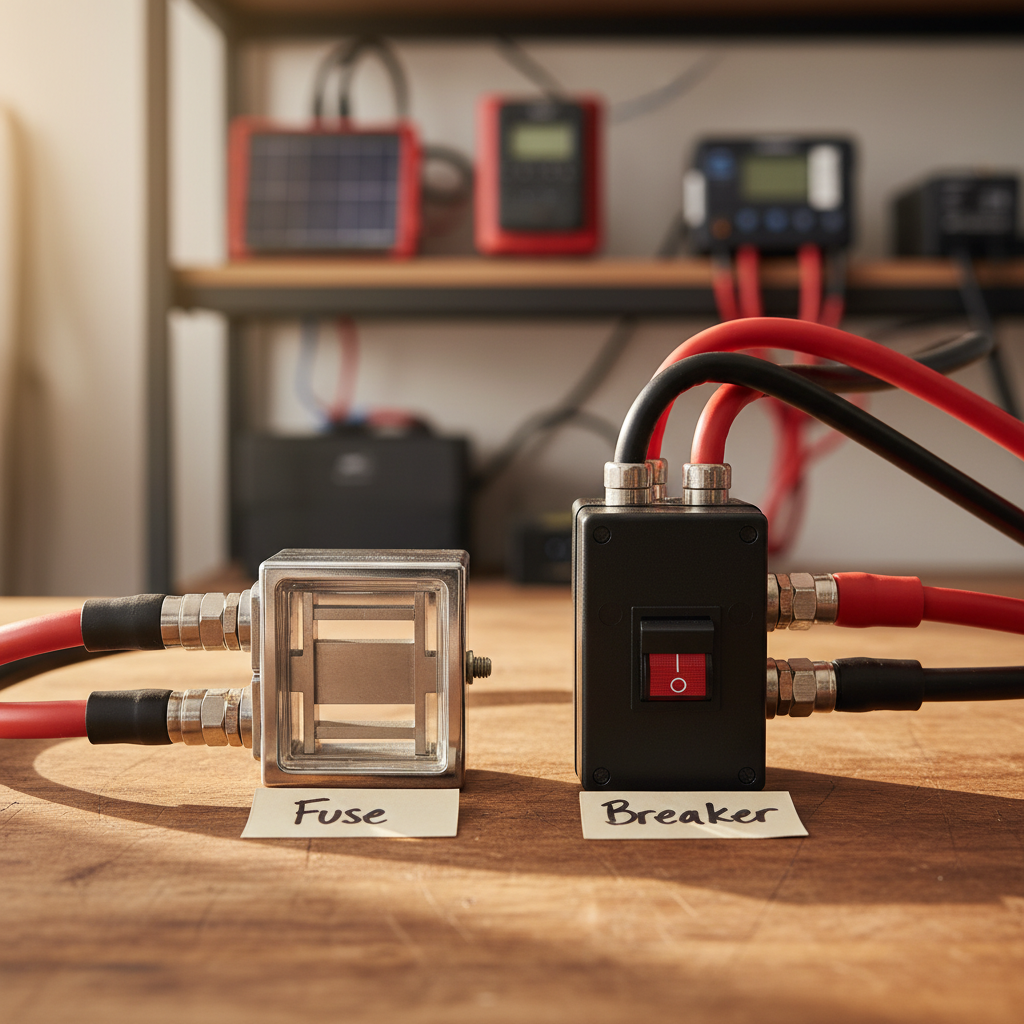
Let’s talk about something everyone mentions but nobody actually explains: solar fuses vs breakers. You’ve read it a hundred times. “Install overcurrent protection.” Great. Thanks. But which one? Where? What size? And why does it cost $4 in one aisle and $40 in the next?
I learned this the hard way. Bought the wrong thing twice before I understood the actual difference. You won’t have to.
Why Overcurrent Protection Actually Matters
Here’s the short version: wires can only handle so much current. Push too much through them and they heat up. Heat up enough and you’ve got a fire. Not a metaphor. An actual fire. In your van, your roof, or your living room.
Overcurrent protection – whether that’s a fuse or a breaker – is the thing that sacrifices itself before your wiring does. Think of it as a designated driver for your electrical system. It takes the hit so everything else gets home safe.
If you’re still figuring out how much power your system actually needs, start with Solar Panel Sizing: Calculate Your Power Needs before worrying about protection devices.
Solar Fuses vs Breakers: The Core Difference
Both devices do the same job – interrupt the circuit when current gets too high. But they do it differently, and that difference matters.
Fuses: One-and-Done Protection
A fuse is a sacrificial piece of metal. When too much current flows through it, the metal melts. Circuit opens. Problem stopped. Fuse dead.
That’s it. Simple, reliable, cheap. The downside? Once it blows, you replace it. No reset button. You need a spare on hand, or you’re stuck.
Fuses respond fast – often faster than breakers. For battery connections especially, that speed matters. A dead short near a large lithium bank can dump enormous current in milliseconds. A slow-responding device won’t save your wiring in time.
Common fuse types you’ll see in solar builds:
- ANL fuses – large, bolt-down style, used for main battery connections (100A-400A range)
- Blade fuses – the kind you know from cars, used for smaller loads (5A-40A)
- MIDI fuses – mid-range, good for charge controllers and smaller inverters (30A-100A)
- Class T fuses – fast-acting, high-current, used near large lithium batteries
Breakers: The Resettable Option
A circuit breaker does the same interruption job, but with a mechanical switch. Trip it once, reset it, and you’re back in business. No replacement needed.
That convenience has real value. If you’re testing a new load or chasing a fault, a breaker lets you reset without digging through your parts kit. For loads you switch on and off regularly, a breaker doubles as a disconnect switch. That’s genuinely useful.
The tradeoffs: breakers cost more upfront, they’re physically larger, and some cheaper DC breakers don’t handle solar voltages as well as their AC ratings suggest. Always verify the DC voltage rating, not just the amp rating.
Common breaker types in DIY solar:
- DIN rail breakers – modular, clean, great for combiner boxes and panels
- Marine-style breakers – compact, resettable, popular in RV and van builds
- DC disconnect breakers – higher voltage rated, used between panels and charge controllers
Where Each One Makes Sense in a Solar System
Here’s where people get confused. It’s not fuses OR breakers everywhere. Most real systems use both. The trick is knowing where each one earns its place.
Main Battery Connection: Use a Fuse
The wire between your battery bank and everything else carries the most potential fault current in the whole system. If something goes wrong here, it goes wrong fast and hot.
Put an ANL or Class T fuse as close to the positive battery terminal as possible. Within 18 inches if you can manage it. This is non-negotiable. A breaker here is slower to respond and usually overkill for cost. The ANL fuse does the job for $8-$15.
If you’ve read our Solar Fusing: Protect Your DIY System From Fire post, you already know this. But it bears repeating every single time.
Charge Controller to Battery: Fuse or Breaker
Either works here. A breaker is handy because it also acts as a disconnect when you’re doing maintenance. Size it at 125% of the charge controller’s rated output current. A 40A MPPT controller gets a 50A fuse or breaker on the battery side.
Solar Panels to Charge Controller: Fuse (Sometimes)
This one surprises people. You don’t always need a fuse between your panels and your charge controller – but if you’re wiring multiple strings in parallel, you do. Each string needs its own fuse to protect against backfeed from the other strings.
Single string? The charge controller often handles it. Multiple strings? Use a combiner box with individual string fuses. Don’t skip this.
Inverter Connection: ANL Fuse
Inverters – especially big ones – can pull hundreds of amps at startup. The connection between your battery and inverter needs a properly rated ANL fuse, installed close to the battery. This protects the fat cable runs that inverters demand.
And those cable runs matter. Oversized wire with proper overcurrent protection is a team effort. Check out Solar Wire Gauge Calculator: Don’t Fry Your System to make sure your wire and protection are matched correctly.
Individual Loads: Breakers Win Here
For your 12V loads – lights, fans, USB chargers, fridge – small breakers or fused distribution blocks make daily life easier. Breakers here work great because you actually reset them. A blown fuse on your fridge circuit at 11pm is annoying. A tripped breaker is a two-second fix.
Amp Ratings: What You Actually Need
The golden rule: protect the wire, not the device. Your fuse or breaker rating should match the wire’s ampacity, not the load’s draw.
Example: if you’re running 10 AWG wire rated for 30A, your fuse should be 30A or less. Even if the load only pulls 15A, a 60A fuse on 10 AWG wire means the wire melts before the fuse blows. That’s the opposite of protection.
Quick reference most DIYers use:
- 10 AWG → 30A max fuse
- 8 AWG → 40-50A max fuse
- 6 AWG → 55-65A max fuse
- 4 AWG → 70-85A max fuse
- 2 AWG → 95-110A max fuse
- 2/0 AWG → 150-175A max fuse
When in doubt, go slightly smaller. A fuse that blows occasionally is telling you something useful. A fuse that never blows because it’s oversized is just decoration.
Cost Reality Check
Let’s be honest about money, because that’s part of every DIY decision.
ANL fuse holders run $8-$20. The fuses themselves are $3-$10 each. For main battery protection, this is the cheapest reliable solution available. Hard to argue with that.
Decent DC breakers start around $15-$25 for smaller ratings and climb fast for higher amperage. A 200A DC breaker for a main disconnect can run $40-$80 or more. That’s not outrageous, but it adds up across a full system build.
The hybrid approach most experienced builders use: ANL fuses for high-current, critical protection points. Breakers for convenience locations where you’ll be resetting or switching regularly. Best of both worlds without blowing the budget.
The Quick Decision Guide
Still not sure which to use where? Run through this:
- Is this the main battery connection? → ANL fuse, always.
- Will you reset this regularly or use it as a switch? → Breaker.
- Is this a one-time install you’ll never touch? → Fuse is fine.
- Is cost the primary concern? → Fuse wins.
- Multiple parallel panel strings? → Individual string fuses, full stop.
Don’t Overthink This
Solar fuses vs breakers isn’t a debate with a single winner. They’re tools. Use the right one in the right place.
Fuses are fast, cheap, and reliable. Breakers are convenient and reusable. Neither one works if it’s sized wrong, installed in the wrong location, or skipped entirely because “it’ll probably be fine.”
It won’t be fine. I say this with love and the memory of a melted wire lug.
Once your protection strategy is sorted, the next logical step is making sure everything actually performs the way you expect. Solar Load Testing: Verify Your DIY System Actually Works walks you through confirming your system under real conditions – protection included.
Build it right. Protect it properly. And keep a few spare fuses in your parts kit. Future you will be grateful.