
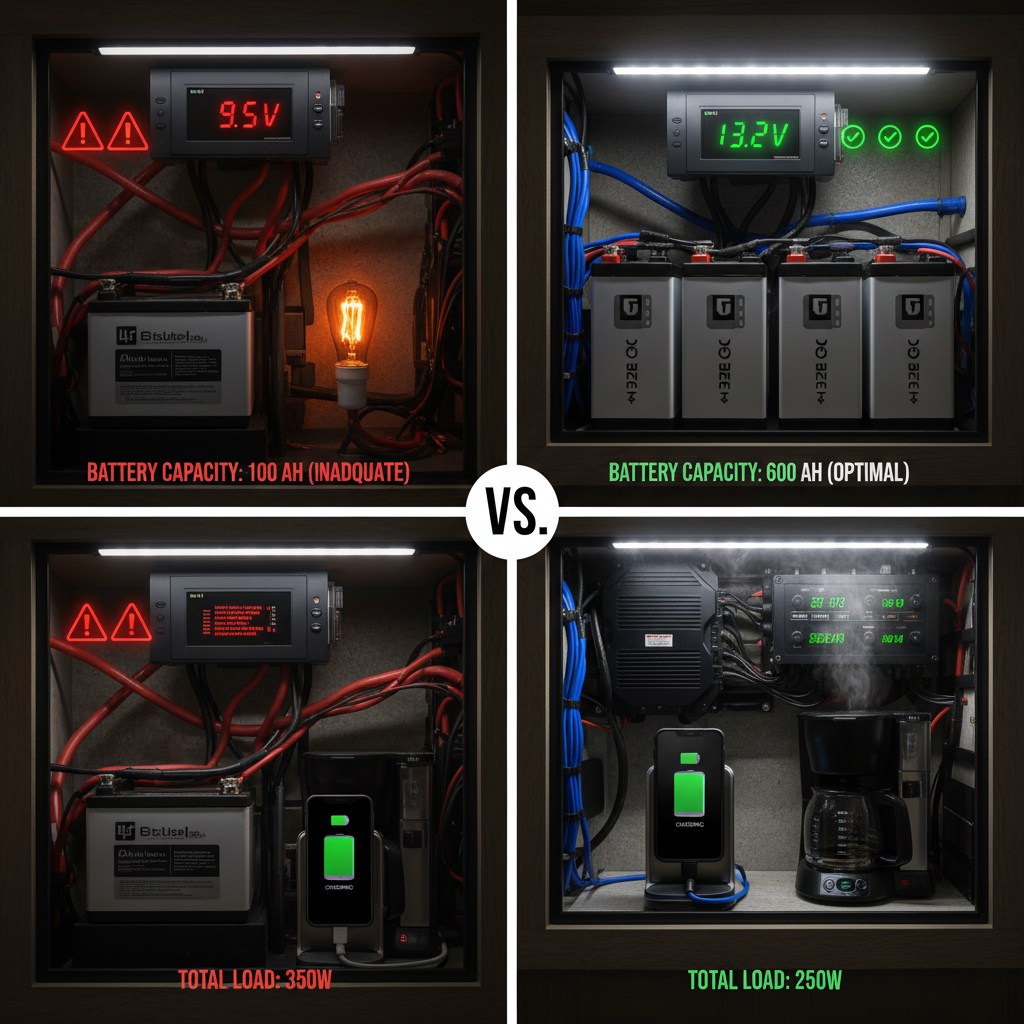
My first RV battery bank lasted exactly three days of boondocking before dying a spectacular death. Turns out wishful thinking isn’t a valid electrical engineering principle. Who knew? If you’re tired of RV battery bank sizing guides that assume you live on sunshine and good vibes, you’ve come to the right place.
Here’s the brutal truth about RV battery bank sizing: most people get it wrong because they calculate what they want to use, not what they actually use. I learned this the expensive way so you don’t have to.
Why Most RV Battery Bank Calculations Fail
Every RV forum is full of people asking “how big should my battery bank be?” Then someone inevitably replies “200Ah should be plenty” without asking a single question about actual usage.
That’s like asking “how much food should I buy?” without mentioning if you’re feeding a hamster or a linebacker. Context matters. A lot.
The real problem? Most calculations assume perfect conditions:
- Your batteries always charge to 100%
- You never run them below 50%
- Temperature is always perfect
- Your power consumption estimates are spot-on
In reality, none of these things happen consistently. Your RV battery bank needs to handle the worst-case scenarios, not the Instagram-worthy ones.
The Coffee Maker Reality Check
I once met a guy with a 100Ah battery bank who couldn’t figure out why his batteries died every morning. Turns out his coffee maker pulled 150 amps for 10 minutes. That’s 25Ah just for coffee.
One cup of coffee consumed 25% of his entire battery capacity. Math is unforgiving like that.
Calculate Your Actual RV Battery Bank Needs
Forget the generic calculators that ask about “lights” and “fans.” We’re doing this properly. Get a notebook and track your actual power consumption for a week. Not what you think you use. What you actually use.
Here’s my reality-based approach:
Step 1: Audit Your Real Power Draws
List every electrical device in your RV. Everything. That 12V fan, the LED strips, the phone chargers, the mysterious thing that beeps at 3 AM.
For each device, write down:
- Watts (or amps)
- Hours used per day
- Daily amp-hours consumed
Don’t guess. Measure. A simple multimeter will save you thousands in oversized battery banks or undersized disappointment.
Step 2: Add the Hidden Power Drains
Your RV has phantom loads you’re not thinking about:
- Propane detector: 1-2 amps continuous
- CO detector: 1 amp continuous
- Inverter standby: 1-3 amps
- Refrigerator control board: 1-2 amps
- Water pump cycling: 8-12 amps when running
These “little” draws add up fast. They’re pulling power 24/7, even when you’re sleeping.
I’ve seen people calculate their battery needs perfectly, then wonder why their batteries die overnight. Phantom loads are battery killers.
Step 3: The Brutal Math
Once you have your total daily amp-hour consumption, it’s time for reality math:
Daily consumption × 2 = minimum battery capacity
Why double it? Because you shouldn’t discharge most batteries below 50%. Also because your initial consumption estimate is probably wrong. Mine always is.
For lithium batteries, you can use a 1.3 multiplier instead of 2. But honestly? Go with 2 anyway. You’ll thank me later when you’re not rationing phone charging.
RV Battery Bank Size Examples That Actually Work
Let’s look at real scenarios, not the fantasyland examples you see everywhere else.
The Minimalist Setup
- LED lighting: 3 hours × 2 amps = 6Ah
- Phone charging: 4 hours × 1 amp = 4Ah
- 12V fan: 8 hours × 1.5 amps = 12Ah
- Water pump: 30 minutes × 10 amps = 5Ah
- Phantom loads: 24 hours × 2 amps = 48Ah
Total: 75Ah daily
Minimum RV battery bank: 150Ah (preferably 200Ah to account for aging and temperature effects)
The Comfortable Camper
- Everything above, plus:
- Laptop: 4 hours × 5 amps = 20Ah
- TV/Entertainment: 3 hours × 8 amps = 24Ah
- Coffee maker: 10 minutes × 150 amps = 25Ah
- Microwave: 15 minutes × 120 amps = 30Ah
Total: 174Ah daily
Minimum battery bank: 350Ah (400Ah if you want breathing room)
Notice how quickly the numbers climb once you add real conveniences? This is why “200Ah is plenty” advice falls apart fast.
The Kitchen Sink Approach
Some folks want to run everything:
- Air conditioning: 8 hours × 150 amps = 1,200Ah
Stop right there. You’re not running AC off batteries for 8 hours. Not unless you have a battery bank the size of a small car. Even 800Ah of lithium only gives you about 2 hours of AC runtime.
Want to run high-draw appliances? You need a generator or shore power. Batteries are for the quiet hours, not for pretending you’re plugged in.
Common RV Battery Bank Sizing Mistakes
I’ve made all of these. Learn from my expensive education:
Mistake #1: Ignoring Temperature
Cold kills battery capacity. Your 200Ah battery bank becomes 160Ah at 32°F and 120Ah at 0°F. Plan accordingly if you camp in shoulder seasons.
Hot weather isn’t much better. Batteries age faster, charge controllers throttle back, and everything gets inefficient above 85°F.
Mistake #2: Forgetting About Charging Time
A massive battery bank is useless if you can’t charge it. Your solar panel sizing needs to match your battery capacity.
Rule of thumb: you need at least 1 watt of solar per 1Ah of battery capacity for reliable charging. More is better.
Got 400Ah of batteries? You need at least 400W of solar. Preferably 600-800W if you want to charge on cloudy days or through dirty panels.
Mistake #3: Mixing Battery Types
Don’t mix AGM and lithium. Don’t mix old and new batteries. Don’t mix different brands or capacities. I know it’s tempting to “make do” with what you have, but batteries need to be matched.
One weak battery drags down the whole bank. It’s like having a relay team where one runner has a broken leg. Everyone suffers.
If you’re still deciding between battery types, check out our AGM vs lithium guide before you commit to a technology.
Budget-Smart RV Battery Bank Planning
Here’s the secret nobody talks about: you don’t need to buy your entire RV battery bank at once. Start with what you can afford and expand later.
But plan your electrical system for the final size from day one. Install the right charge controller, inverter capacity, and wire gauge for your ultimate goal.
Adding batteries later is easy. Rewiring your entire electrical system because you undersized everything? That’s expensive and frustrating.
The Smart Expansion Path
- Start with 50% of your calculated needs
- Monitor actual usage for a few months
- Add capacity based on real data, not estimates
- Leave room for one more expansion in your budget and space
This approach lets you learn your actual usage patterns without breaking the bank upfront. Plus you’ll catch any calculation errors before they get expensive.
RV Battery Bank Maintenance Reality
A properly sized battery bank is easier to maintain than an undersized one. Oversized batteries run gentler cycles, last longer, and give you more margin for error.
Undersized banks get abused. They’re constantly deep-cycled, never fully charged, and die young. False economy at its finest.
Your monitoring should include voltage, current draw, and state of charge. Not just “the lights work.” Real data prevents real problems.
The Bottom Line on RV Battery Bank Sizing
Size your RV battery bank for your worst camping day, not your best one. The day when it’s cloudy, you’re stuck inside, and everything needs charging at once.
Start with real consumption data, double it for safety margin, then add 20% more because you forgot something. Your future self will thank you when you’re not rationing electrons.
Remember: it’s cheaper to buy extra battery capacity upfront than to replace an undersized system later. Trust me on this one. I’ve got the receipts to prove it.
And if you’re planning to test your system under real loads, start with a properly sized battery bank. Testing with inadequate batteries just tells you that inadequate batteries are inadequate. Not very useful.
Size it right the first time. Your wallet and your weekend camping trips will thank you.