
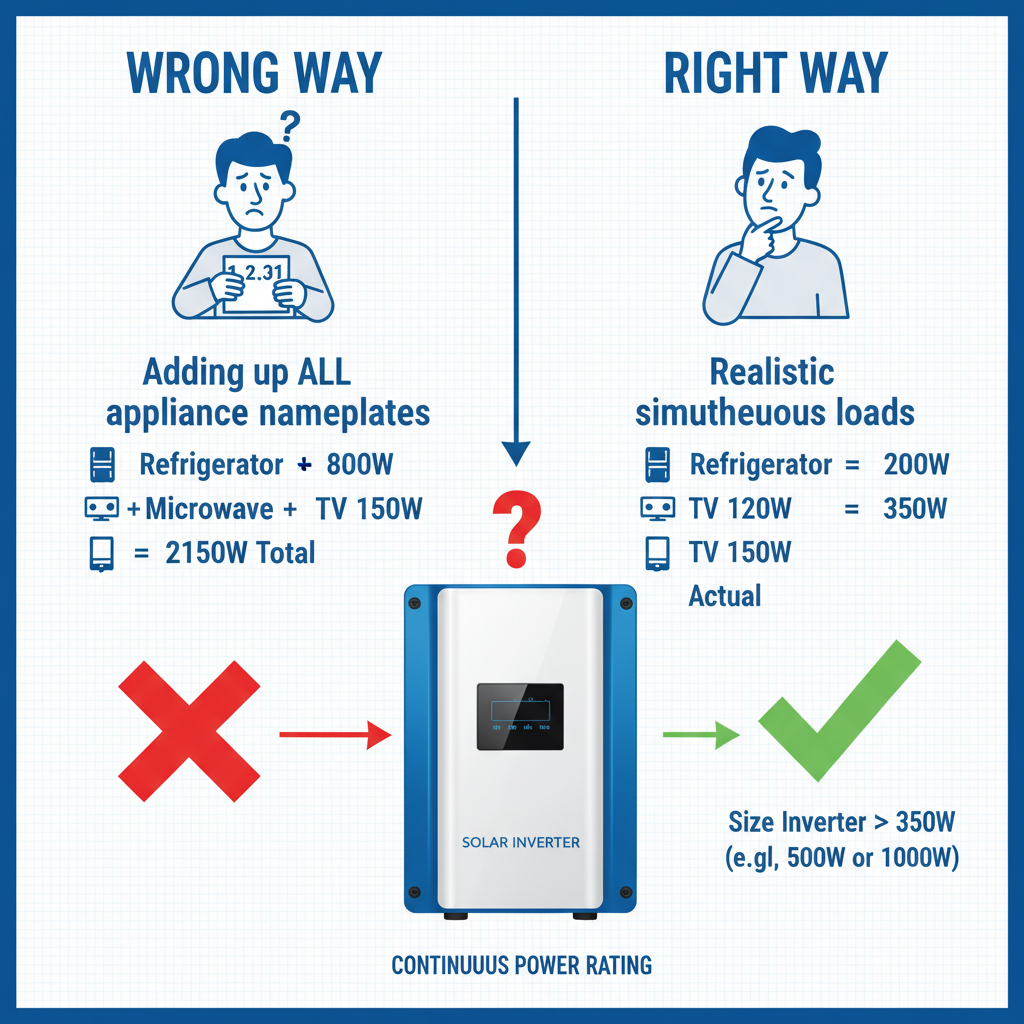
Here’s what I wish someone had told me before I bought my first solar inverter sizing disaster: you don’t need to size your inverter to handle every appliance in your house. You just need it to handle what you’ll actually run at the same time. Simple concept. Terrible execution on my part.
I bought a 3000W inverter because my spreadsheet said I “needed” it. Then I realized I was paying for capacity I’d never use. My coffee maker and microwave don’t run simultaneously. My drill press isn’t on when I’m watching TV.
Let me save you from my expensive education in solar inverter sizing.
Why Solar Inverter Sizing Matters More Than You Think
Get this wrong and you’ll either blow your inverter or blow your budget. Maybe both.
Undersized inverters shut down when you exceed their capacity. Not gracefully. They just quit. Usually when you’re trying to run the vacuum and someone turns on the hair dryer.
Oversized inverters cost more upfront and waste energy running at low loads. They’re also less efficient when you’re only using 10% of their capacity.
The sweet spot? Size for your realistic simultaneous loads, not your theoretical maximum.
Calculate Your Actual Simultaneous Load
This is where solar inverter sizing gets practical instead of theoretical.
First, make a list of everything you’ll run on solar power. Everything. Include starting watts for motors and compressors – they draw 3-7 times their running watts for the first few seconds.
Here’s my method: walk through your typical day and note what’s actually running at the same time. Not what could run. What does run.
Morning scenario: coffee maker (800W), LED lights (60W), phone charger (20W). That’s 880W total.
Evening scenario: TV (150W), laptop (65W), LED lights (100W), phone chargers (40W). That’s 355W total.
Weekend project scenario: drill (500W starting, 300W running), shop lights (200W), radio (30W). That’s 530W continuous after startup.
See the pattern? Your simultaneous loads are probably way lower than your total possible loads.
Don’t Forget the Surge Factor
Motors, compressors, and power tools need extra startup power. Your inverter needs to handle these surges without shutting down.
If you’re running a circular saw (1400W running, 4200W starting), your inverter needs surge capacity even if your continuous load is reasonable.
Most quality inverters handle 2x their rated power for surges. A 1500W inverter can typically handle 3000W surges for a few seconds.
Common Solar Inverter Sizing Mistakes
I’ve made most of these. Learn from my wallet’s pain.
Mistake #1: Adding up nameplate ratings. Your refrigerator nameplate says 800W, but it only runs 200W most of the time. Use actual consumption, not nameplate ratings.
Mistake #2: Ignoring duty cycles. Your well pump might be 1200W, but it only runs 15 minutes per hour. That’s not a continuous load.
Mistake #3: Future-proofing too much. “I might add a hot tub someday” isn’t a sizing strategy. Size for what you’ll install in the next year.
Mistake #4: Forgetting inverter efficiency. Your inverter uses power just being on. Factor in 5-15% efficiency losses.
Speaking of efficiency, if you haven’t already calculated your energy needs properly, check out our Solar Panel Sizing: Calculate Your Power Needs Guide first.
Practical Inverter Sizing Examples
Let’s walk through some real scenarios.
Small Cabin Setup
Loads: LED lighting (100W), small TV (75W), laptop charging (65W), DC refrigerator (40W average).
Simultaneous load: 280W continuous. Add 20% safety margin: 336W.
Recommendation: 600W inverter with good surge capacity.
Why 600W instead of 400W? Surge capacity and efficiency. Inverters run most efficiently at 40-80% of rated capacity.
RV Boondocking Setup
Loads: Microwave (1000W), coffee maker (800W), TV (100W), LED lights (80W), laptops (130W), 12V fridge (DC, doesn’t count).
Key insight: microwave and coffee maker never run together. Microwave runs 5 minutes max. Coffee maker runs 10 minutes max.
Simultaneous load: 1000W (microwave) + 310W (everything else) = 1310W.
Recommendation: 1500W inverter.
For more RV-specific considerations, our guide on Solar Inverter Types: Pure Sine vs Modified DIY Guide covers the technical details.
Home Backup Power
Critical loads only: refrigerator (150W average, 600W starting), freezer (100W average, 400W starting), LED lights (200W), internet/router (50W).
Simultaneous starting surge: 600W + 400W + 250W = 1250W for a few seconds.
Continuous load: 500W.
Recommendation: 1000W inverter with 2000W surge capacity.
Size for Your Battery Bank Too
Your solar inverter sizing needs to match your battery capacity and chemistry.
Lead-acid batteries shouldn’t discharge faster than C/5 (20% of capacity per hour). Lithium batteries can handle higher discharge rates.
If you have 400Ah of lead-acid batteries at 12V (4800Wh total), your safe continuous draw is about 960W. Size your inverter accordingly.
Battery chemistry matters here. Our AGM vs Lithium: Solar Battery Chemistry Guide for DIY explains the discharge rate differences.
Installation and Safety Considerations
Big inverters need big wires and proper fusing. A 3000W inverter at 12V draws 250 amps. That’s serious current.
Wire gauge matters. A lot. Undersized wires create voltage drop, heat, and fire hazards.
Fusing protects everything. Every positive connection needs proper overcurrent protection.
Don’t cheap out on safety. Your house burning down isn’t worth saving $50 on wire gauge.
When to Upsize vs Downsize
Upsize if:
• You have high-surge loads (well pumps, air compressors)
• You want better efficiency at low loads
• You plan definite additions within 12 months
Downsize if:
• Your calculations show you’ll rarely use full capacity
• You can manage loads manually (run microwave, then coffee maker)
• Budget is tight and efficiency isn’t critical
Testing Your Inverter Size Choice
Before you commit to a permanent installation, test your sizing assumptions.
Use a kill-a-watt meter to measure actual consumption of your devices. Run your typical load combinations and see what you actually draw.
Many people discover their “essential” loads are much lower than calculated.
You can also start smaller and upgrade later. It’s easier to upsize an inverter than downsize buyer’s remorse.
The Bottom Line on Solar Inverter Sizing
Size your inverter for reality, not theory. Calculate your actual simultaneous loads, add a reasonable safety margin, and factor in surge requirements.
Most DIY solar systems need smaller inverters than people think. A well-chosen 1000W inverter often outperforms a poorly-chosen 3000W unit.
Remember: you can always manage loads or add a second inverter. You can’t get your money back from an oversized inverter gathering dust.
Start with what you need today, size it properly, and save the expansion dreams for when they become expansion plans.